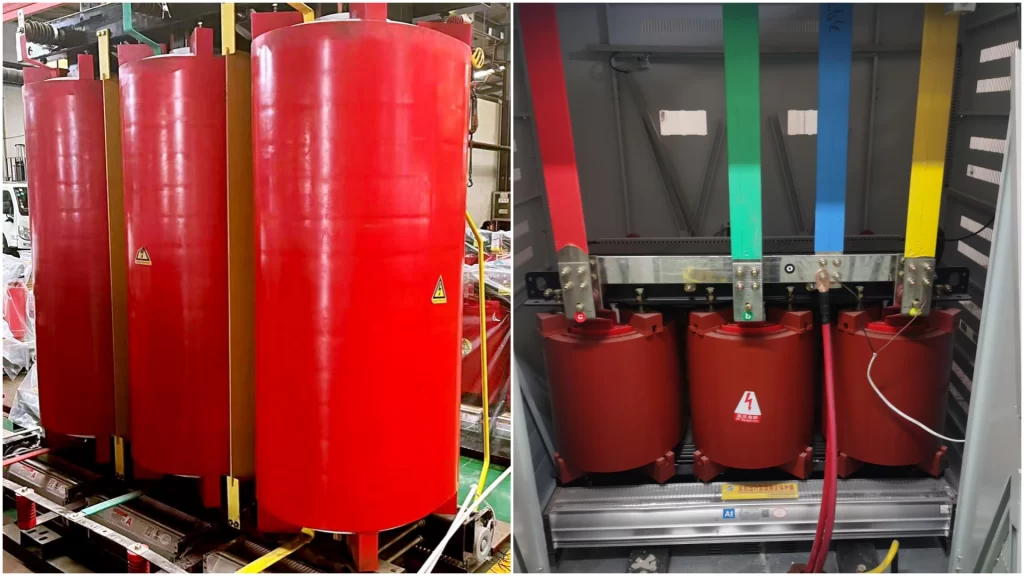
A 건식 변압기 is an electrical transformer that uses air and solid insulation materials instead of insulating oil for electrical insulation and cooling. It transfers electrical energy between circuits through electromagnetic induction and can increase or decrease voltage according to the requirements of an electrical system.
Dry type transformers are widely used in commercial buildings, industrial facilities, data centers, renewable energy systems, transportation infrastructure and power distribution networks. Their oil-free construction makes them particularly suitable for installations where fire safety, environmental considerations and indoor equipment requirements are important.
Available in different configurations, including open-type, enclosed, cast resin and vacuum pressure impregnated (VPI) designs, dry type transformers can be customized according to rated capacity, voltage, winding material, cooling method and installation environment.
This guide explains how dry type transformers work, their main types, technical specifications, advantages, applications, installation requirements and how to select the right transformer for your project.
1. How Does a Dry Type Transformer Work?
A dry type transformer operates on the principle of electromagnetic induction. It transfers electrical energy from a primary circuit to a secondary circuit without a direct electrical connection between the windings in a conventional two-winding design.
When alternating current flows through the primary winding, it generates an alternating magnetic flux in the laminated transformer core. This magnetic flux induces voltage in the secondary winding, allowing electrical power to be transferred at a different voltage level.
The relationship between the primary and secondary voltages is determined by the winding turns ratio.
Transformer Voltage Ratio:
V₁ / V₂ ≈ N₁ / N₂
Where:
V₁ = Primary voltage
V₂ = Secondary voltage
N₁ = Number of primary winding turns
N₂ = Number of secondary winding turns
For example, an 11 kV/0.4 kV dry type transformer reduces medium voltage to a low-voltage level suitable for industrial equipment and building electrical distribution systems.
Main Components of a Dry Type Transformer
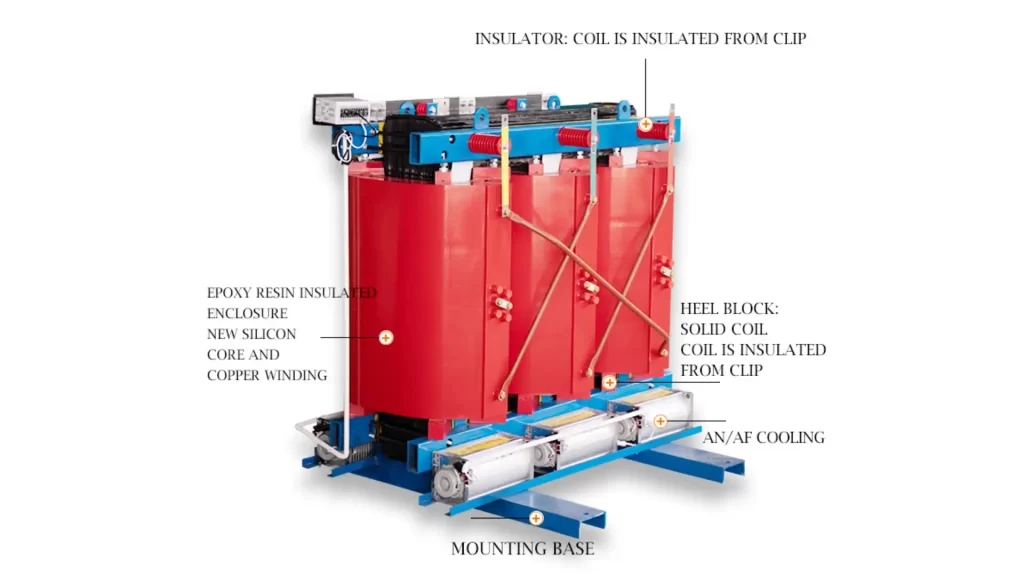
A typical dry type transformer consists of the following components:
Magnetic Core: Usually manufactured from laminated electrical steel to provide an efficient magnetic flux path and reduce core losses.
Primary and Secondary Windings: Made from copper or aluminum conductors, designed according to rated capacity, voltage, current and impedance requirements.
단열 시스템: Uses solid insulation materials, including epoxy resin, insulation films and insulating varnishes, to provide electrical insulation.
냉각 시스템: Uses natural air circulation or forced-air fans to dissipate heat generated during operation.
Temperature Monitoring System: Temperature sensors and monitoring controllers help detect abnormal winding temperatures and provide alarms or protective signals.
Protective Enclosure: An optional metal enclosure protects the transformer against accidental contact, dust and environmental conditions according to the specified IP rating.
The exact construction depends on the transformer capacity, insulation technology and intended installation environment.
2. Types of Dry Type Transformers
Dry type transformers can be classified according to their physical construction, insulation technology and electrical applications.
Understanding these classifications helps engineers and purchasers identify the appropriate transformer for their projects.
2.1 Structural Types: Open-Type and Enclosed Transformers
Open-Type Dry Type Transformer
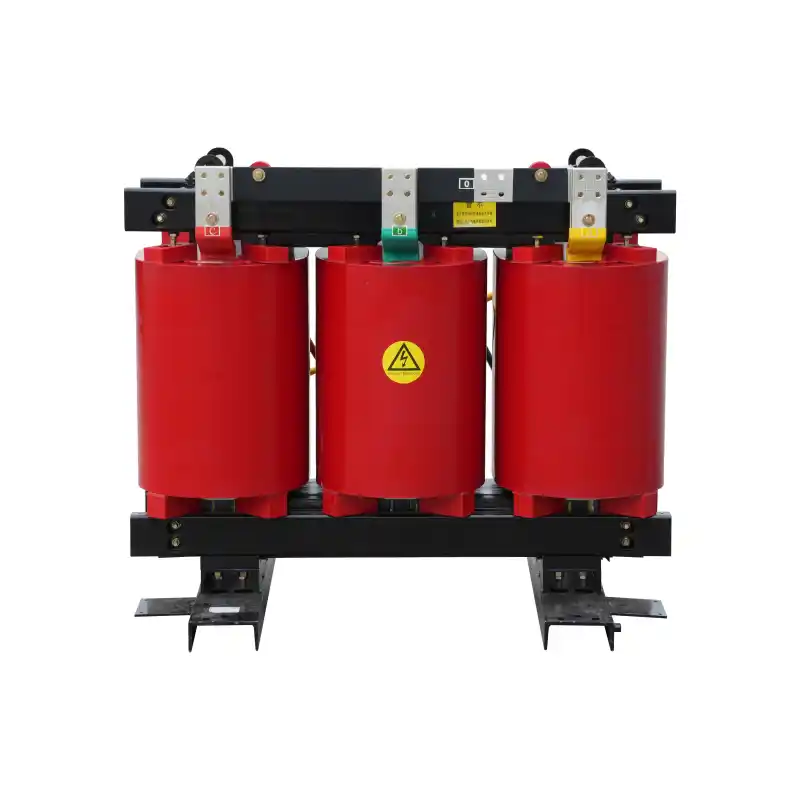
An open-type dry type transformer has an exposed core and winding assembly without a protective metal enclosure.
Its construction allows air to circulate directly around the transformer components, helping dissipate operating heat.
Typical characteristics include:
Exposed core and winding assembly.
Natural air cooling (AN) or forced-air cooling (AF).
Relatively simple construction.
Easy access for inspection and maintenance.
Requires a clean, dry and well-ventilated installation environment.
Open-type transformers are commonly used in indoor electrical rooms and controlled industrial environments.
A 1000 kVA open-type dry type transformer is an example of this configuration.
Enclosed Dry Type Transformer
An enclosed dry type transformer is equipped with a protective metal housing surrounding the core and winding assembly.
The enclosure helps reduce exposure to dust, accidental contact and other external environmental conditions.
Common enclosure protection options include IP20, IP23, IP31 and IP54, depending on project requirements.
Typical characteristics include:
Protective metal enclosure.
Improved protection against external contact and contamination.
Customized ventilation arrangements.
Suitable for selected indoor and outdoor installations when properly designed.
Different cable entry and terminal arrangements.
Specialized mining transformers may require additional mechanical protection and dedicated explosion-proof designs. An ordinary enclosed transformer should not be considered explosion-proof without the appropriate design and certification.
A 2000 kVA mining dry type transformer is an example of a specialized industrial configuration.
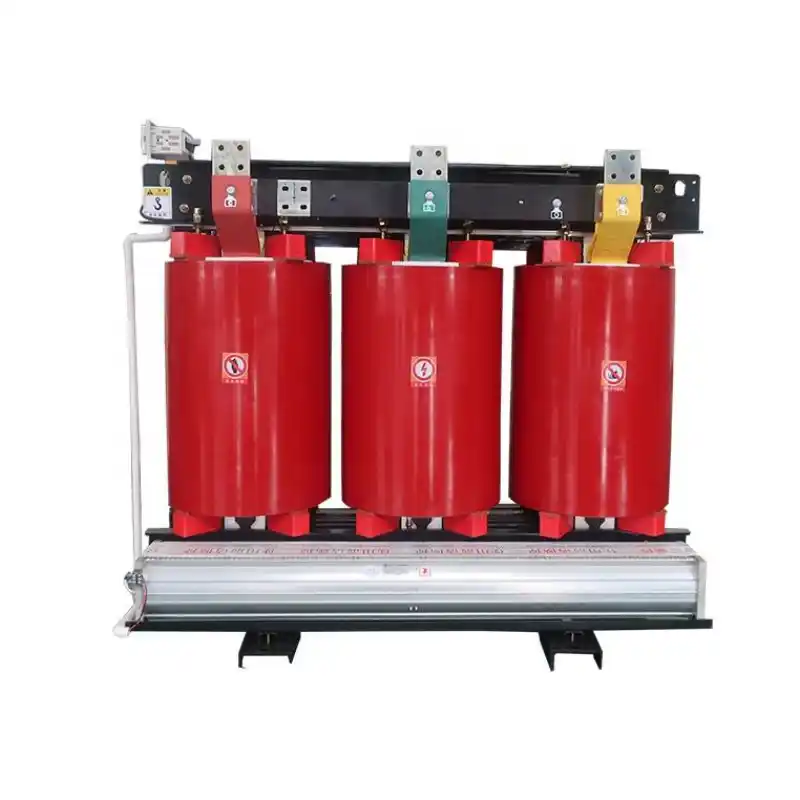
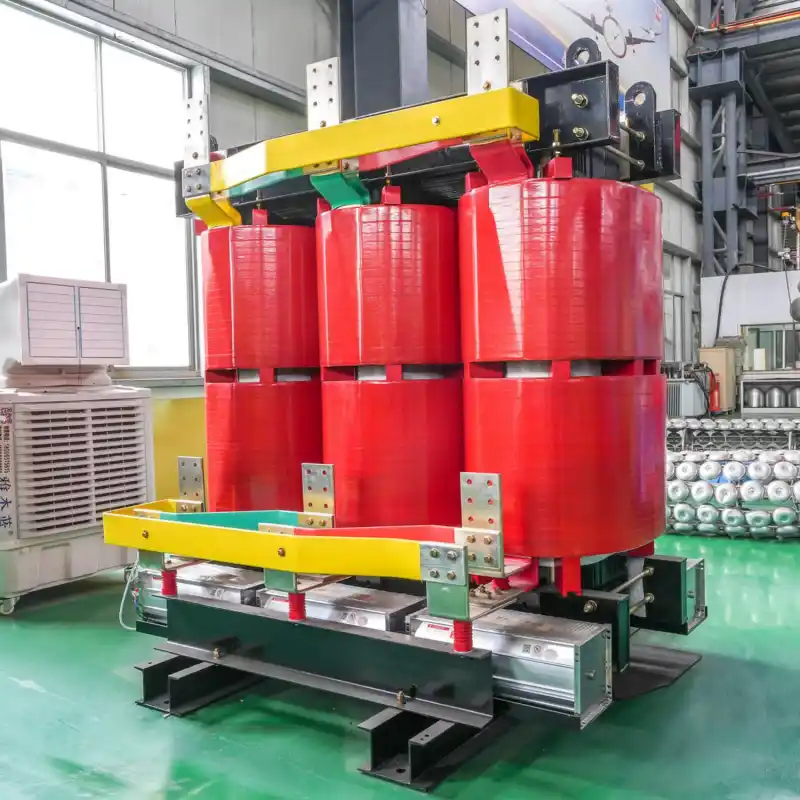
2.2 Cast Resin Dry Type Transformer
A cast resin dry type transformer uses epoxy resin or other suitable insulating resins to encapsulate its windings.
The resin provides electrical insulation and mechanical protection while helping reduce the exposure of the windings to environmental contamination.
Main characteristics include:
Epoxy resin-encapsulated windings.
Good mechanical and insulation performance.
Oil-free construction.
Suitable for many indoor installations.
Available in medium- and large-capacity designs.
Cast resin transformers are widely used in commercial buildings, hospitals, factories, data centers and infrastructure projects.
A 1500 kVA cast resin dry type transformer is one example of this configuration.
It is important to understand that cast resin describes the winding insulation technology, whereas open-type and enclosed-type describe the physical enclosure configuration. A cast resin transformer can also be supplied with a protective enclosure.
2.3 Vacuum Pressure Impregnated (VPI) Transformer
VPI dry type transformers use an insulation process in which the windings are impregnated with insulating varnish or resin under controlled vacuum and pressure conditions.
This process helps improve insulation penetration and mechanical stability.
VPI transformers are commonly used in industrial power distribution, motor systems and electrical equipment applications.
2.4 Other Functional Types of Dry Type Transformers
Depending on their electrical functions, dry type transformers can also be manufactured in several specialized configurations.
These configurations are engineered according to electrical ratings, insulation requirements and operating environments.
3. Dry Type Transformer Technical Specifications
Dry type transformers are available in different capacities, voltage ratings, winding configurations and protection arrangements.
The following table summarizes representative technical options used in commercial and industrial applications.
Common Dry Type Transformer Specifications
These are representative design options rather than a single standard specification. Available combinations depend on transformer capacity, insulation design and project requirements.
Common Dry Type Transformer Capacity Ratings
Typical capacity ratings include:
50 kVA – 100 kVA
160 kVA – 315 kVA
400 kVA – 630 kVA
800 kVA – 1000 kVA
1250 kVA – 1600 kVA
2000 kVA – 2500 kVA
3150 kVA – 5000 kVA
Higher customized capacities subject to technical confirmation.
Common Voltage Configurations
4. Dry Type Transformer Cooling Methods
Cooling is essential for maintaining acceptable winding temperatures, insulation performance and transformer service life.
Unlike conventional oil-immersed transformers, 건식 변압기 generally use air as the cooling medium.
Air Natural Cooling (AN)
Air natural cooling uses natural air circulation around the core and windings to dissipate heat.
It is commonly used in standard dry type transformers operating within their specified thermal limits.
Main characteristics:
No cooling fans required.
Simple cooling arrangement.
Lower auxiliary power consumption.
Fewer mechanical components.
Air Forced Cooling (AF)
Air forced cooling uses fans to increase airflow through or around the transformer.
It can support additional thermal capacity when the transformer is specifically designed and rated for forced-air cooling.
대표적인 특징은 다음과 같습니다:
Cooling fans.
Temperature monitoring.
Automatic fan control where specified.
Improved heat dissipation.
The additional permissible loading must be confirmed through the manufacturer’s thermal design and rating documentation.
Temperature Monitoring and Protection
Dry type transformers may incorporate temperature sensors, monitoring controllers and protective devices.
Common functions include winding temperature monitoring, high-temperature alarms, cooling fan control and high-temperature trip signals.
These systems help operators monitor transformer operating conditions and respond to abnormal temperatures.
5. Dry Type Transformer vs Oil-Immersed Transformer
Dry type and oil-immersed transformers are both widely used in electrical power systems.
Their main differences involve insulation, cooling, installation conditions and maintenance requirements.
When Should You Choose a Dry Type Transformer?
A dry type transformer may be preferred when:
Oil-free construction is important.
The transformer is installed inside a building.
Environmental considerations restrict the use of insulating oil.
Suitable ventilation is available.
The project requires indoor electrical distribution equipment.
When Should You Choose an Oil-Immersed Transformer?
An oil-immersed transformer may be preferred when:
High-capacity outdoor distribution is required.
The project uses an established oil-filled substation design.
The cooling and insulation requirements favor liquid insulation.
The installation provides suitable liquid containment and fire protection.
The best choice depends on capacity, installation conditions, safety requirements and lifecycle costs.
6. Advantages and Disadvantages of Dry Type Transformers
Dry type transformers offer several advantages, but their limitations should also be considered during equipment selection.
장점
Oil-Free Construction
Dry type transformers do not use conventional insulating oil, eliminating oil leakage and oil-handling requirements.
Suitable for Indoor Installation
They are widely used in electrical rooms, commercial buildings and industrial facilities where oil-free equipment is preferred.
Reduced Oil-Related Maintenance
Routine maintenance does not require insulating oil sampling or replacement.
Flexible Design Options
Different voltage ratings, winding materials, enclosure protection levels and cooling configurations can be specified.
Monitoring and Protection
Temperature sensors, monitoring controllers and other protective devices can be incorporated according to project requirements.
Disadvantages
Ventilation Requirements
Adequate airflow is necessary to prevent excessive operating temperatures.
Environmental Sensitivity
Dust, moisture, contamination and corrosive conditions must be considered during installation and enclosure selection.
설치 공간
High-capacity units may require larger installation spaces and suitable ventilation arrangements.
Initial Investment
Depending on capacity, insulation design and enclosure configuration, some dry type transformers may have a higher initial purchase cost than comparable oil-immersed designs.
A complete comparison should consider installation, operating efficiency, maintenance and lifecycle costs.
7. Applications of Dry Type Transformers
Dry type transformers are used in a wide range of commercial, industrial and infrastructure applications.
상업용 건물
Dry type transformers supply electrical power to office buildings, hotels, shopping centers, hospitals and other commercial facilities.
They are commonly installed in indoor electrical rooms and building distribution systems.
Industrial Manufacturing Facilities
Factories use dry type transformers to supply power to production lines, industrial machinery, motors, control equipment and electrical distribution systems.
Customized voltage configurations and winding arrangements can be selected according to industrial load requirements.
데이터 센터
Data centers require reliable electrical distribution infrastructure to support servers, cooling systems and other critical equipment.
Dry type transformers can be integrated into medium-voltage and low-voltage distribution systems according to the facility’s electrical design.
재생 에너지 시스템
Dry type transformers are used in selected renewable energy applications, including solar power plants, wind energy installations and battery energy storage systems.
They can be designed for step-up, step-down or isolation applications according to the electrical system configuration.
Transportation Infrastructure
Airports, railway stations, metro systems and transportation facilities use transformers to supply power to lighting, auxiliary equipment, control systems and distribution networks.
Mining and Marine Applications
Specialized dry type transformers are designed for mining and marine environments.
Mining applications may require additional mechanical protection, environmental protection and hazardous-area compliance.
Marine transformers may require specialized insulation, vibration resistance and applicable marine certification according to vessel requirements.
8. Overload Capacity of Dry Type Transformers
The overload capacity of a dry type transformer depends on its thermal design, insulation system, ambient temperature, cooling method and operating conditions.
A transformer operating above its rated capacity generates additional heat in its windings and core. Excessive temperature can accelerate insulation aging and reduce service life.
Important factors include:
정격 용량: Select the transformer according to the expected maximum electrical load and future load requirements.
Ambient Temperature: High ambient temperatures reduce the available thermal margin.
냉각 방법: Forced-air cooling may support additional loading when specifically designed for this condition.
단열 시스템: The insulation system determines the thermal limits of the transformer design.
Load Profile: The duration, frequency and magnitude of overload conditions influence thermal performance.
Overload capability should be evaluated using manufacturer loading data and applicable engineering guidelines. A universal overload percentage should not be applied to every dry type transformer.
9. Dry Type Transformer Installation and Commissioning
Correct installation and commissioning are essential for reliable transformer operation.
Unpacking and Visual Inspection
Before installation, check for:
Transport damage.
Loose or damaged components.
Winding contamination.
Damaged terminals or insulation.
Missing accessories.
Incorrect nameplate information.
Any abnormal condition should be reported before installation.
Foundation and Installation Requirements
The transformer should be installed on a suitable foundation capable of supporting its operating weight.
Important considerations include floor loading capacity, correct positioning, maintenance access, electrical clearances and vibration requirements.
Ventilation and Clearance
Dry type transformers require adequate ventilation to dissipate operating heat.
The installation should provide sufficient airflow around the transformer and its cooling openings. Enclosed transformers should have ventilation arrangements suitable for their thermal design.
Electrical Connections and Pre-Energization Inspection
Primary and secondary cables should be connected according to approved electrical drawings.
Before energization, qualified personnel should verify:
Correct phase sequence.
Terminal identification and connection tightness.
Cable sizing and neutral connection.
Tap position.
Protective earthing.
Insulation resistance.
Winding resistance and turns ratio where specified.
Temperature monitoring and cooling fan operation where applicable.
Testing should follow the manufacturer’s instructions, applicable standards and project commissioning procedures.
10. Wiring Connections and Vector Groups
The winding connection determines the electrical relationship between the primary and secondary circuits.
Common three-phase transformer connections include:
Common vector groups include Dyn11, Yyn0, YNd11 and Dd0.
The correct vector group should be selected according to the system grounding arrangement, phase displacement, parallel operation requirements and project specifications.
11. Grounding of Dry Type Transformers
Grounding is essential for electrical safety and power system protection.
The grounding arrangement depends on the winding configuration and electrical distribution system.
Enclosure Grounding: Metal enclosures should be connected to the protective earthing system according to applicable electrical requirements.
Core Grounding: The transformer core is normally grounded through the manufacturer’s designated grounding arrangement. Unintended multiple grounding connections should be avoided.
Neutral Grounding: The secondary neutral may be grounded directly, through an impedance or according to another approved system grounding arrangement.
Protective Earthing: Accessible conductive components and associated electrical equipment should be integrated into the facility protective earthing system.
All grounding arrangements should follow approved electrical drawings, manufacturer instructions and applicable standards.
12. Dry Type Transformer Fault Diagnosis and Maintenance
Although dry type transformers do not require insulating oil maintenance, they still need periodic inspection and condition monitoring.
Common Problems
Abnormal Transformer Noise
Unusual humming, vibration or mechanical noise may indicate loose components, core vibration, improper mounting, harmonic distortion or mechanical resonance.
Overheating
Excessive operating temperature may result from overloading, blocked ventilation, cooling fan failure, high ambient temperature or loose electrical connections.
Insulation Deterioration
Insulation deterioration may be associated with excessive heat, moisture, contamination, electrical stress or aging.
Dust and Moisture Contamination
Accumulated dust and moisture can affect insulation performance and heat dissipation.
Routine Maintenance Checklist
Recommended inspection activities include:
Visual inspection of windings and insulation.
Checking electrical connections.
Cleaning ventilation passages.
Inspecting cooling fans.
Reviewing temperature monitoring records.
Checking grounding connections.
Investigating abnormal noise and vibration.
Performing electrical tests when required.
Maintenance frequency should be determined by the operating environment, equipment condition and manufacturer’s recommendations.
13. How to Select the Right Dry Type Transformer
Selecting the correct dry type transformer requires consideration of the electrical system, installation environment and operating conditions.
Before requesting a quotation, confirm the following technical parameters:
Important Purchasing Considerations
로드 요구 사항: Determine the actual operating load, expected maximum demand and potential future expansion.
Electrical Compatibility: Verify voltage, frequency, phase arrangement, neutral requirements and grounding configuration.
환경 조건: Consider ambient temperature, altitude, humidity, dust, ventilation and installation location.
Efficiency and Losses: Evaluate no-load losses, load losses and efficiency requirements according to applicable standards.
Maintenance and Serviceability: Consider access for inspection, cleaning, testing and replacement of accessories.
A complete technical specification helps manufacturers select a suitable transformer design and prepare an accurate quotation.
14. Frequently Asked Questions About Dry Type Transformers
What is a dry type transformer?
A dry type transformer is an electrical transformer that uses solid insulation and air as its cooling medium instead of conventional insulating oil. It is commonly used in commercial buildings, industrial facilities and electrical distribution systems.
What are the main types of dry type transformers?
Common types include cast resin, VPI, isolation, distribution, rectifier, autotransformer and specialized industrial designs. They can also be classified by enclosure construction, including open-type and enclosed configurations.
What is the difference between open-type and enclosed dry type transformers?
Open-type transformers have exposed core and winding assemblies, while enclosed transformers are equipped with protective metal housings. Enclosed designs provide additional protection against external contact and environmental contamination.
What is the difference between cast resin and VPI transformers?
Cast resin transformers use epoxy resin or other suitable insulating resin to encapsulate their windings. VPI transformers use insulating varnish or resin applied through a vacuum pressure impregnation process.
Are dry type transformers suitable for outdoor installation?
Yes. Dry type transformers can be designed for outdoor installation when suitable enclosures, ventilation and environmental protection are provided. The specified protection level should match the installation conditions.
What cooling methods are used in dry type transformers?
The two common cooling methods are Air Natural (AN) and Air Forced (AF). Natural air circulation is used in AN designs, while AF designs incorporate fans to increase airflow.
What is the difference between dry type and oil-immersed transformers?
Dry type transformers use solid insulation and air cooling, while oil-immersed transformers use insulating liquid for insulation and cooling. The choice depends on capacity, installation environment, fire safety requirements and operating conditions.
What is the typical capacity range of dry type transformers?
Dry type transformers are available in a wide range of capacities, from smaller distribution units to multi-MVA industrial transformers. Higher-capacity designs are available depending on engineering and project requirements.
What standards apply to dry type transformers?
IEC 60076-11 is an important international standard covering dry type power transformers. Additional standards, efficiency requirements and certification requirements depend on the destination market and project specifications.
How long does a dry type transformer last?
The service life depends on insulation aging, operating temperature, loading conditions, environmental conditions and maintenance. Proper transformer selection and operation help support long-term reliability.
결론
Dry type transformers provide reliable voltage transformation without conventional insulating oil and are widely used in commercial buildings, industrial facilities, data centers, renewable energy systems and infrastructure projects.
Understanding the differences between open-type, enclosed, cast resin and VPI designs helps engineers and purchasers select suitable transformer configurations.
From insulation technology and cooling methods to voltage ratings, capacity and enclosure protection, every transformer should be designed according to its intended operating environment and technical requirements.
Evernew Transformer provides dry type transformer solutions, including cast resin, VPI, isolation, distribution and customized industrial transformers.
Explore our Dry Type Transformer product range for product configurations and technical information, or contact our team to discuss your project requirements and request a quotation.
