
引言
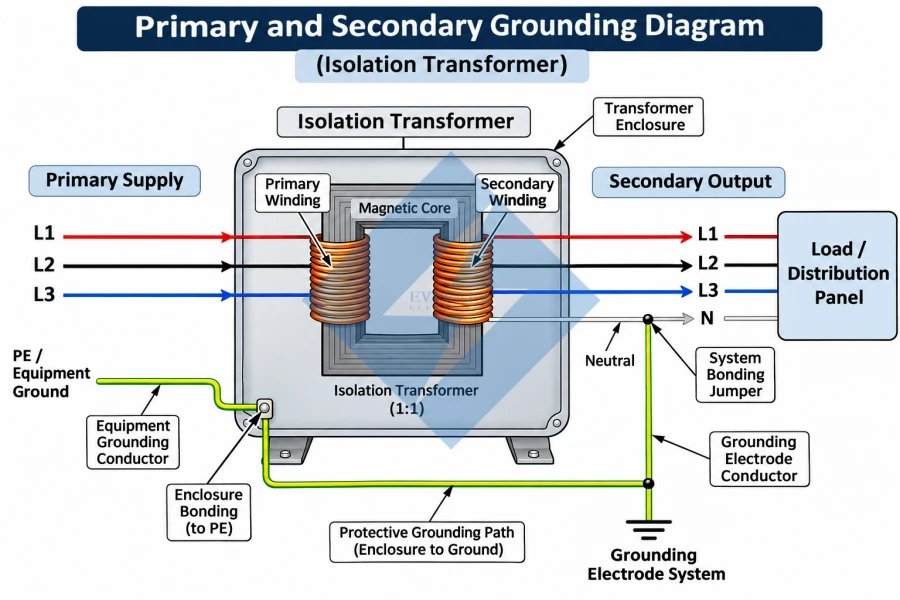
Proper grounding is essential for the safe and reliable operation of an isolation transformer. Although an isolation transformer electrically separates its primary and secondary windings, this separation does not eliminate the need for protective grounding and bonding.
An improperly designed grounding system can create electrical safety hazards, unwanted circulating currents and problems with protective device operation.
For industrial machinery, CNC equipment, automation systems, laboratories and other sensitive electrical applications, understanding three grounding arrangements is particularly important:
Primary-side equipment grounding
Secondary-side system grounding
Electrostatic shield grounding
This guide explains how these grounding connections work, their differences and the key considerations when selecting or installing a dry type isolation transformer.
For different industrial electrical requirements, explore Evernew’s range of single-phase and three-phase isolation transformers, featuring customized voltage configurations, winding materials and optional electrostatic shielding.
1. Why Is Grounding Important for an Isolation Transformer?
An isolation transformer transfers electrical energy through electromagnetic induction while maintaining electrical separation between its primary and secondary windings.
Grounding serves several important purposes.
Electrical shock protection: Protective grounding connects exposed conductive components, including the transformer enclosure, to an appropriate fault-current path.
Secondary voltage reference: Depending on the electrical system design, the secondary winding may require a grounded neutral or another approved grounding arrangement.
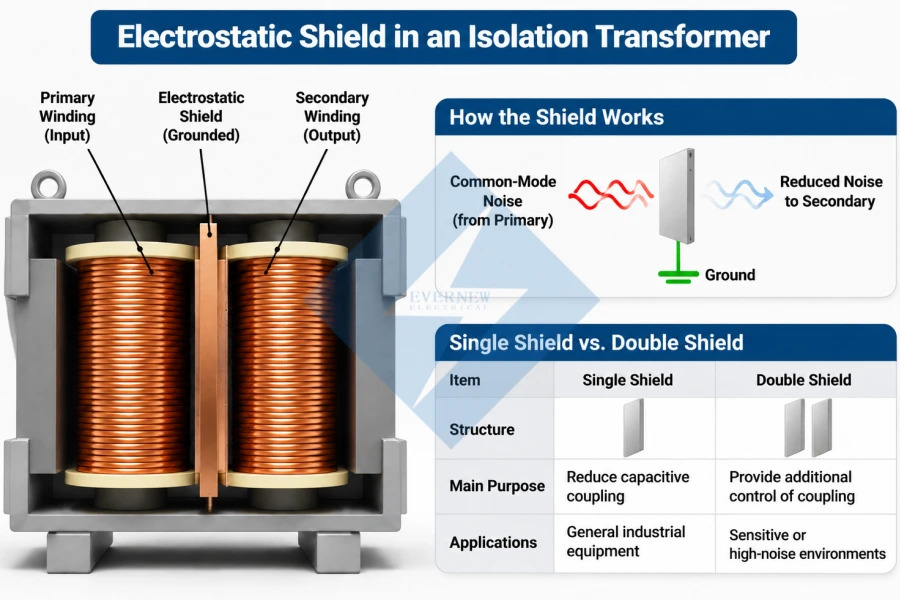
Electrical noise reduction: An appropriately grounded electrostatic shield can reduce capacitive coupling between primary and secondary windings, helping limit the transfer of certain common-mode disturbances.
Protective device operation: An effective grounding and bonding system helps provide a suitable fault-current path so that protective devices can operate under the required fault conditions.
It is important to understand that galvanic isolation does not replace protective grounding or guarantee complete electrical noise elimination.
2. Primary-Side Grounding of an Isolation Transformer
Primary-side grounding mainly concerns the incoming power supply, transformer enclosure, core and other exposed conductive components.
The primary electrical circuit and the transformer enclosure grounding system serve different purposes.
2.1 Primary Equipment Grounding
The incoming supply normally includes phase conductors and an equipment grounding conductor (PE or EGC), as required by the electrical installation.
The equipment grounding conductor connects to the designated grounding terminal on the transformer enclosure.
A simplified arrangement is:
Primary Power Supply → Primary Protection → Primary Winding
Equipment Grounding Conductor → Transformer Enclosure
The protective grounding conductor normally does not carry operating load current. It provides a path for fault current under abnormal conditions.
2.2 Core and Enclosure Bonding
The transformer core, core clamps, enclosure and other exposed conductive components must be bonded according to the manufacturer’s design.
For dry type isolation transformers, installers should use the designated grounding terminals and follow the approved installation drawings.
Mechanical contact between painted metal surfaces should not be assumed to provide reliable electrical bonding.
2.3 Primary Grounding Considerations
Use appropriately sized equipment grounding conductors.
Connect grounding conductors to designated terminals.
Ensure reliable bonding of exposed conductive components.
Follow the manufacturer’s installation instructions.
Verify grounding continuity before energizing the transformer.
3. Secondary-Side Grounding: Grounded vs. Ungrounded Systems
The secondary winding of an isolation transformer forms an electrically separate circuit.
In many installations, particularly North American applications, a transformer supplying a new grounded secondary system is treated as a separately derived system (SDS).
The grounding arrangement must be designed according to the applicable electrical code and system configuration.
3.1 Grounded Secondary System
A common industrial configuration uses a three-phase transformer with a star-connected secondary winding.
例如:
This configuration provides:
208 V between any two phases.
120 V between any phase and neutral.
The secondary neutral point can be used as the system grounding reference.
For a grounded separately derived system, the required system bonding jumper and grounding electrode conductor must be installed according to applicable requirements, including NEC Article 250.30 where applicable.
The grounding arrangement generally involves:
Secondary neutral point
System bonding jumper
Equipment grounding system
Grounding electrode conductor
Grounding electrode system
The neutral-to-ground bonding connection must be installed at the permitted location. Unnecessary additional neutral-to-ground bonds downstream can create parallel current paths and unwanted current on equipment grounding conductors.
3.2 Ungrounded Secondary System
Some specialized industrial applications use an intentionally ungrounded secondary system.
In this arrangement, neither secondary current-carrying conductor is intentionally connected to earth as the system grounding reference.
However, the transformer enclosure and connected equipment must still have appropriate protective grounding.
Ungrounded systems may be considered where continuity of operation is important. They require suitable ground-fault detection or insulation monitoring, together with procedures for responding to the first ground fault.
Their suitability depends on the application, electrical protection design and applicable codes.
3.3 Grounded vs. Ungrounded Secondary
Neither configuration is universally better. The correct arrangement depends on the electrical system and safety requirements.
4. Electrostatic Shield Grounding in Isolation Transformers
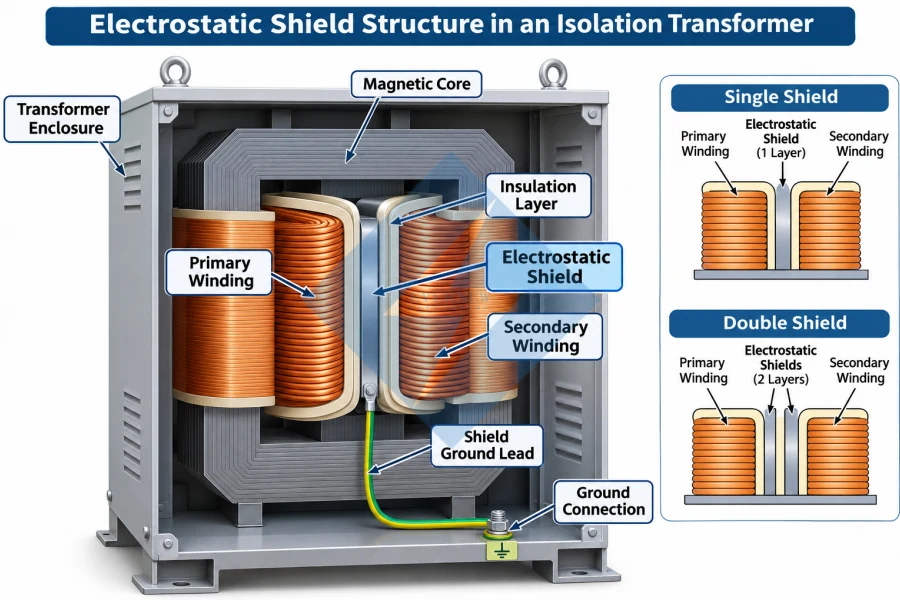
An electrostatic shield is an optional conductive layer installed between the primary and secondary windings of certain isolation transformers.
It is commonly made from copper or aluminum and is designed to reduce capacitive coupling between the windings.
When properly grounded, the shield provides a path for intercepted displacement currents and helps reduce the transfer of certain common-mode electrical disturbances.
4.1 How Should an Electrostatic Shield Be Grounded?
The shield must have a grounding connection designed by the transformer manufacturer.
Depending on the transformer construction, the shield grounding lead may be connected to an internal grounding point or provided as a separate terminal for installation.
重要考量事項包括:
Reliable electrical connection to the designated grounding point.
Proper bonding of the transformer enclosure.
Appropriate grounding conductor routing.
Electrical insulation between the shield and both windings.
Compliance with the manufacturer’s wiring diagram.
Not all isolation transformers use the same shield grounding arrangement.
4.2 Single Shield vs. Double Shield
Depending on the application, isolation transformers can incorporate single or double electrostatic shielding.
Double shielding does not automatically provide twice the noise attenuation. Actual performance depends on shield construction, grounding impedance, transformer design and installation conditions.
For sensitive industrial applications, the required shielding arrangement should be evaluated during the engineering design stage.
Learn more about single and double electrostatic shielding in isolation transformers and how different shielding configurations can be selected for industrial electrical applications.
5. Common Isolation Transformer Grounding Mistakes
Incorrect grounding can affect both electrical safety and transformer performance.
The following mistakes should be avoided.
1. Leaving the transformer enclosure ungrounded
Galvanic isolation does not eliminate the requirement for protective grounding of exposed metallic components.
2. Connecting neutral and ground at multiple locations
Unnecessary downstream neutral-to-ground connections can create parallel current paths and objectionable current on grounding conductors.
3. Leaving the electrostatic shield disconnected
An electrostatic shield must be connected to its designated grounding point to perform its intended function.
4. Assuming every isolation transformer includes shielding
An isolation transformer does not automatically include an electrostatic shield. Single or double shielding must be specified and confirmed during manufacturing.
5. Using an earth electrode as a substitute for equipment bonding
A grounding electrode connection alone does not replace the required equipment grounding and bonding path.
6. Ignoring installation drawings
Primary, secondary, neutral, protective earth and shield connections should be clearly identified before installation and commissioning.
6. How to Specify Grounding Requirements When Ordering an Isolation Transformer
Grounding requirements should be clarified during technical specification review and drawing approval.
Customers should provide the following information:
For applications involving CNC machines, automation systems and sensitive electronic equipment, additional grounding and shielding requirements may need engineering evaluation.
A complete wiring diagram should identify primary and secondary connections, neutral terminals, protective earth connections, enclosure bonding points and electrostatic shield grounding terminals.
For additional information about transformer types, voltage configurations, technical specifications and product selection, read our Isolation Transformer Types, Specifications and Applications Guide.
7. Evernew Isolation Transformer Manufacturing and Customization
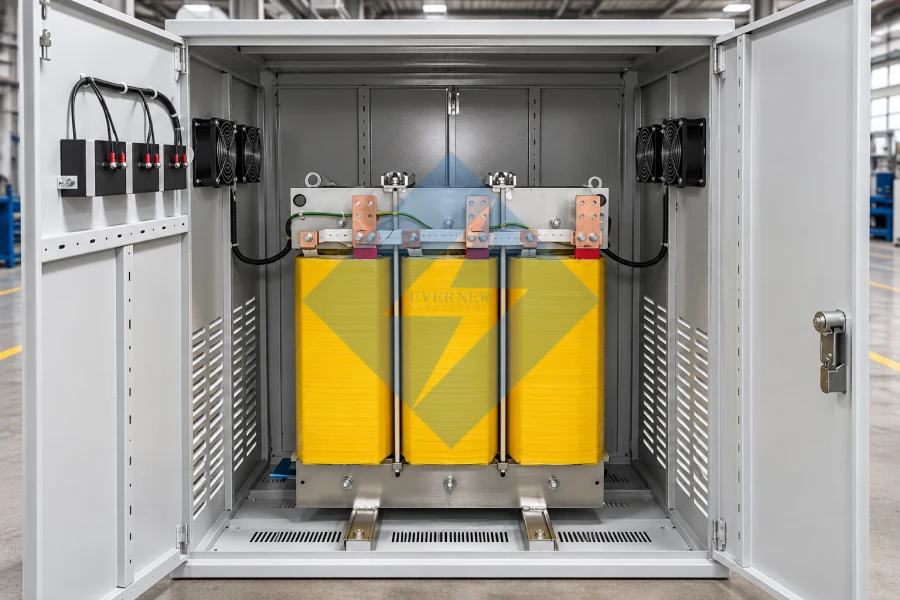
Evernew Transformer provides customized dry type isolation transformer solutions for industrial, commercial and specialized electrical applications.
Our engineering team can review customer specifications and develop transformer configurations according to electrical requirements and installation conditions.
Available customization options include:
Single-phase and three-phase designs.
Customized primary and secondary voltages.
銅製或鋁製繞組。.
50 Hz and 60 Hz operation.
Customized vector groups.
Optional single or double electrostatic shielding.
Different insulation systems and cooling configurations.
Customized enclosures and protection levels.
Project-specific grounding terminals and wiring arrangements.
Evernew supports customized isolation transformer manufacturing across a range of capacities, with larger ratings subject to engineering evaluation.
Whether you require a 480V to 208Y/120V isolation transformer, a 690V to 400V industrial isolation transformer or a customized double-shielded transformer, our engineering team can review your requirements.
Discover more dry type transformer solutions for industrial and commercial power distribution applications.
联系恒新变压器 for technical consultation, customized specifications and factory-direct quotations.
8. Frequently Asked Questions About Isolation Transformer Grounding
Does an isolation transformer need to be grounded?
Yes. The transformer enclosure and exposed conductive components require appropriate protective grounding and bonding. The secondary grounding arrangement depends on the electrical system design and applicable codes.
Should both the primary and secondary of an isolation transformer be grounded?
The primary equipment grounding system and secondary system grounding serve different purposes. The enclosure must be protectively grounded, while the secondary neutral or another circuit conductor is grounded according to the designed system.
Does an isolation transformer require a neutral-to-ground bond?
Not every installation uses the same arrangement. When the secondary is designed as a grounded separately derived system, the required system bonding jumper must be installed at the permitted location.
Does an electrostatic shield need to be grounded?
Yes. An electrostatic shield must be connected to its designated grounding point according to the manufacturer’s design to provide its intended shielding function.
Can an isolation transformer operate with an ungrounded secondary?
Yes, in certain properly designed systems. However, protective equipment grounding is still required, and suitable ground-fault monitoring and protection must be provided.
结论
Proper grounding is essential for the safe and reliable operation of an isolation transformer.
Primary equipment grounding protects the transformer enclosure and exposed conductive components. Secondary grounding establishes the appropriate electrical reference for the output system, while electrostatic shield grounding helps reduce capacitive coupling between primary and secondary windings.
These arrangements must be coordinated during transformer design, installation and commissioning.
For industrial applications requiring electrical isolation and additional noise reduction, selecting the correct grounding and shielding configuration is just as important as choosing the transformer capacity and voltage ratio.
Looking for a customized isolation transformer? Contact Evernew Transformer for engineering support, technical specifications and customized manufacturing solutions.
