
Buying power transformers from China can provide international buyers with access to extensive manufacturing capacity, customized engineering solutions, and competitive factory-direct pricing. However, sourcing a transformer is considerably more complex than purchasing standard electrical equipment.
A power transformer must meet specific electrical, mechanical, environmental, safety, and regulatory requirements. Selecting a supplier based solely on the lowest quotation can lead to technical incompatibility, unexpected costs, delivery delays, or long-term operational problems.
Whether you are an EPC contractor, utility company, electrical distributor, renewable energy developer, or industrial project owner, understanding the transformer procurement process is essential.
This guide explains how to buy power transformers from China, evaluate manufacturers, prepare technical specifications, compare quotations, verify quality, and arrange international delivery.
It also introduces the manufacturing and engineering capabilities of Evernew Transformer and its manufacturing partner, Jiangsu Yawei Transformer.
1. Why Buy Power Transformers from China?
China is an established manufacturing center for electrical power equipment, including distribution transformers, high-voltage power transformers, dry-type transformers, and packaged substations.
For international buyers, sourcing from China can offer several advantages.
1.1 Extensive Manufacturing Capabilities
Chinese transformer manufacturers supply equipment for applications ranging from low-voltage industrial distribution to high-voltage transmission systems.
Depending on the manufacturer, available products may include:
Medium- and 고전압 전력 변압기
Pad-mounted and 극 장착형 변압기
Renewable energy step-up transformers
Special-purpose industrial transformers
Manufacturers with established engineering and production facilities can also support customized voltage ratios, winding configurations, cooling systems, and accessories.
1.2 Competitive Manufacturing Costs
Chinese transformer factories may offer competitive prices due to established supply chains, specialized production equipment, and access to electrical steel, copper, aluminum, insulation materials, and fabricated components.
However, the purchase price depends on several technical and commercial factors.
A transformer with copper windings, low guaranteed losses, special insulation requirements, and advanced monitoring equipment may cost significantly more than a basic model with the same kVA rating.
The lowest transformer price does not necessarily represent the lowest lifetime cost.
1.3 Custom Engineering Support
International transformer projects frequently require non-standard designs.
For example, an Australian project may require a 2500 kVA, 11/0.433 kV, 50 Hz transformer with a specific enclosure arrangement and local efficiency requirements.
A North American project may instead require a 60 Hz transformer designed around IEEE/ANSI requirements, specific insulation levels, and applicable energy-efficiency regulations.
A capable manufacturer should review these requirements before confirming the final design and price.
1.4 Export and Logistics Experience
Experienced transformer exporters can coordinate technical documentation, export packing, factory inspection, shipping arrangements, and customs documentation.
For large power transformers, logistics planning is especially important because transportation dimensions, total weight, oil handling, and installation requirements can affect project costs.
2. How to Find a Reliable Power Transformer Manufacturer in China
One of the most important steps in transformer procurement is identifying whether a potential supplier has the technical and manufacturing capabilities required for your project.
Not every company advertising transformers online operates its own factory.
2.1 Transformer Factory vs. Trading Company
Both factories and trading companies can play legitimate roles in international procurement. The important consideration is understanding who is responsible for engineering, manufacturing, testing, and after-sales support.
| EVALUATION CRITERIA | DIRECT MANUFACTURER | TRADING COMPANY |
|---|---|---|
| Manufacturing Facilities | Operates production facilities | Usually sources from manufacturers |
| 기술 설계 | Typically has engineering resources | May coordinate with external engineers |
| Factory Inspection | Can arrange direct production inspection | Depends on manufacturing partner |
| 사용자 지정 | Direct production coordination | Depends on supplier network |
| Quality Responsibility | Factory-controlled production processes | Requires clear supplier coordination |
| Pricing | Factory-direct commercial structure | May include intermediary services |
A trading company is not automatically less reliable than a factory. Some provide valuable sourcing, logistics, and technical coordination services.
For complex or high-value transformer projects, buyers should identify the actual manufacturer and establish clear responsibility for design approval and testing.
2.2 Verify Manufacturing Facilities
Before placing a major order, request evidence of the supplier’s production capabilities.
Useful information includes:
Factory location and company registration details
Transformer assembly and winding workshops
Core cutting and manufacturing equipment
Oil processing and vacuum treatment facilities
High-voltage testing equipment
Engineering and quality control personnel
Previous manufacturing experience with comparable transformers
For high-value projects, a factory visit or independent inspection may be appropriate.
2.3 Review Technical Experience
A manufacturer producing standard 400 kVA distribution transformers may not necessarily have the facilities required for a 100 MVA or 220 kV power transformer.
Buyers should request evidence of comparable projects, including:
Rated capacity and voltage class
Transformer configuration
적용 기준
Testing records
Manufacturing history
Relevant customer references, where available
The objective is to confirm experience with equipment similar to the proposed purchase.
2.4 Check Certifications and Quality Documentation
Request the manufacturer’s relevant quality management certificates and product-specific documentation.
Depending on the market and transformer design, applicable requirements may include IEC, IEEE, ANSI, CSA, UL, or national energy-efficiency regulations.
Buyers should verify the exact scope and validity of any certification.
A general factory quality management certificate does not automatically mean every transformer model is independently certified for every destination market.
3. What Technical Specifications Are Required for a Transformer RFQ?
A Request for Quotation (RFQ) is the starting point for an accurate transformer offer.
Incomplete technical information can result in pricing discrepancies, design changes, and delays during engineering review.
A well-prepared RFQ should clearly define the transformer’s electrical ratings, operating conditions, required accessories, and applicable standards.
Power Transformer RFQ Checklist
| 매개변수 | INFORMATION REQUIRED / EXAMPLE |
|---|---|
| 변압기 유형 | Oil-Immersed / Dry-Type |
| 정격 용량 | 2500 kVA / 10 MVA / 50 MVA |
| 기본 전압 | 11 kV / 33 kV / 110 kV |
| 2차 전압 | 433 V / 11 kV / 33 kV |
| 빈도 | 50Hz / 60Hz |
| 단계 수 | Single-Phase / Three-Phase |
| 벡터 그룹 | Dyn11 / YNd11 / YNyn0 |
| 와인딩 재료 | 구리 / 알루미늄 |
| 냉각 방법 | ONAN / ONAF / AN / AF |
| 임피던스 | Required percentage |
| 탭 체인저 | Off-Circuit Taps / OLTC |
| 탭 범위 | ±2 × 2.5% / ±10% |
| 무부하 손실 | Maximum permitted value |
| 부하 손실 | Maximum permitted value and reference temperature |
| 절연 수준 | Applicable BIL / LI / AC withstand requirements |
| 설치 | 실내/실외 |
| 주변 온도 | Minimum and maximum temperature |
| Installation Altitude | Meters above sea level |
| 적용 기준 | IEC / IEEE / CSA / Local Standards |
| Required Accessories | Cable Boxes, CTs, Indicators, Relays, etc. |
| 수량 | Number of Units |
| Delivery Destination | Country, Port, or Project Site |
Not every project requires every parameter to be fixed before the initial inquiry. However, the more complete the RFQ, the easier it is for the manufacturer to prepare a technically accurate offer.
3.1 Rated Capacity and Voltage
Transformer capacity is generally expressed in kVA or MVA.
The required rating should be determined from the electrical load, anticipated demand, operating conditions, and any future expansion requirements.
Voltage ratios must also match the connected electrical network.
예를 들어:
2500 kVA – 11/0.433 kV – 50 Hz – Dyn11
This identifies a three-phase transformer with an 11 kV high-voltage winding, a 433 V low-voltage winding, and a Dyn11 connection group.
3.2 Copper vs. Aluminum Windings
Both copper and aluminum are used in transformer manufacturing.
Copper generally offers higher electrical conductivity per unit volume, while aluminum may provide advantages in material cost and weight.
The final design depends on conductor dimensions, thermal performance, losses, mechanical strength, and manufacturing requirements.
Buyers should specify the winding material when it is a contractual requirement.
3.3 Transformer Cooling Methods
Cooling configuration affects the transformer’s thermal performance and operating rating.
Common designations include:
| COOLING METHOD | DESCRIPTION |
|---|---|
| ONAN | Oil Natural Air Natural |
| ONAF | Oil Natural Air Forced |
| OFAF | Oil Forced Air Forced |
| AN | Air Natural |
| AF | Air Forced |
| AN/AF | Natural and Forced Air Cooling |
For example, an oil-immersed transformer with ONAF cooling uses forced air circulation to improve heat dissipation.
The manufacturer should confirm the guaranteed rating under each applicable cooling stage.
3.4 Impedance and Vector Group
Transformer impedance influences short-circuit current, voltage regulation, and parallel operation.
Vector group determines winding connections and phase displacement.
These parameters must be compatible with the electrical system.
They should not be selected solely to reduce manufacturing cost.
3.5 Environmental and Installation Requirements
Transformer design must account for the actual operating environment.
Important considerations include:
주변 온도
고도
Humidity and pollution
Coastal or corrosive environments
Seismic requirements
실내 또는 실외 설치
Space and transportation restrictions
A transformer intended for a high-altitude mining site may require a different thermal or insulation design from one installed at sea level.
4. Understanding IEC, IEEE and Local Transformer Standards
International transformer procurement requires more than selecting the correct voltage and capacity.
The equipment must satisfy the standards and regulatory requirements applicable to its installation location.
4.1 IEC Standards
The IEC 60076 series is widely used for power transformers in many international markets.
Relevant parts address subjects such as general requirements, temperature rise, insulation levels, short-circuit withstand capability, and dry-type transformer requirements.
The specific edition and applicable parts should be stated in the project specification.
4.2 IEEE and ANSI Standards
IEEE C57 standards are commonly used in North American transformer applications.
These standards cover transformer ratings, testing, insulation, performance, and other design requirements.
North American projects may also require compliance with applicable efficiency regulations and product certification requirements.
4.3 Australian Transformer Requirements
Australian projects may reference IEC standards together with relevant Australian or Australian/New Zealand standards and energy-efficiency requirements.
Depending on transformer type and application, standards such as AS 60076 and applicable distribution transformer efficiency requirements may be relevant.
IEC compliance alone should not be assumed to demonstrate compliance with every Australian regulatory requirement.
Buyers should provide the applicable standard editions, required losses, testing requirements, and any local certification obligations.
4.4 Why Standard Verification Matters
A transformer may meet the electrical requirements of IEC 60076 but still require additional design verification for a specific destination market.
Before finalizing an order, confirm:
Applicable standard and edition
Guaranteed electrical performance
효율 및 손실 요건
Required tests and certificates
Installation and safety requirements
For customized transformers, the manufacturer should confirm compliance against the agreed technical specification rather than relying on a generic product description.

5. How to Compare Power Transformer Quotations from China
A transformer quotation should be evaluated on technical and commercial completeness, not only on the unit price.
Two transformers with the same rated capacity and voltage may have substantially different manufacturing costs.
5.1 Compare Technical Specifications First
Before comparing prices, confirm that each quotation uses the same technical basis.
| COMPARISON ITEM | WHY IT MATTERS |
|---|---|
| 정격 용량 | Determines required output capability |
| Voltage Ratio | Must match the electrical system |
| 와인딩 재료 | Affects design and material cost |
| 핵심 재료 | Influences no-load losses |
| Guaranteed Losses | Affects operating expenditure |
| 냉각 시스템 | Affects thermal performance |
| 임피던스 | Affects system coordination |
| 액세서리 | May significantly affect price |
| 적용 기준 | Determines compliance requirements |
| Testing Scope | Affects quality verification |
| 보증 | Defines contractual support |
| Packing and Delivery | Affects landed cost |
A quotation without guaranteed losses, clearly defined accessories, or an agreed testing scope may not be directly comparable with a fully specified offer.
5.2 Consider Transformer Lifetime Costs
Transformer ownership costs include more than the initial purchase price.
A useful evaluation considers:
Total Cost of Ownership = Purchase Cost + Transportation and Installation + Energy Loss Costs + Maintenance and Other Lifecycle Costs
No-load losses occur whenever the transformer is energized.
Load losses depend on operating load and generally vary approximately with the square of load current under comparable operating conditions.
For transformers operating continuously over many years, differences in guaranteed losses can materially affect lifetime costs.
5.3 Understand What Is Included in the Price
Before accepting a quotation, confirm whether the offer includes:
Export packing
Cable boxes or termination arrangements
Protection devices
Temperature indicators
Cooling fans
Tap changer and controls
공장 내 시험
Spare parts
Technical documentation
Transportation and insurance
These items should be explicitly identified in the quotation or technical agreement.
5.4 Avoid Comparing Preliminary and Final Quotations
An initial budget quotation may be based on incomplete project information.
After detailed engineering review, the manufacturer may need to revise the price to reflect confirmed standards, losses, accessories, cooling requirements, or manufacturing details.
For procurement approval, buyers should use the final technically reviewed quotation rather than an earlier preliminary estimate.
6. Transformer Procurement Process: From RFQ to Delivery
A structured purchasing process helps reduce misunderstandings between the buyer, engineering team, manufacturer, and logistics provider.
Typical Transformer Procurement Workflow
Submit RFQ — Provide ratings, standards, quantities, accessories, and destination.
Technical Review — Confirm design feasibility, losses, insulation, cooling, and special requirements.
Quotation & Commercial Review — Compare prices, delivery terms, payment, and warranty.
Contract & Drawing Approval — Finalize technical agreements and approve required drawings.
Manufacturing — Complete core, winding, assembly, insulation, and other production processes.
Factory Acceptance Testing — Perform agreed inspections and tests.
Packing & Shipment — Arrange export packing, transport, and shipping documents.
Delivery & Commissioning — Complete site inspection, installation, and commissioning as required.
Step 1: Submit a Detailed RFQ
Provide the technical parameters and any available drawings, single-line diagrams, or project specifications.
If the project is at the tender stage, clearly identify whether the requested price is budgetary or binding.
Step 2: Complete Technical Review
The manufacturer reviews the electrical requirements, mechanical design, cooling method, losses, and applicable standards.
Technical clarification questions may be required before an accurate quotation can be issued.
Step 3: Review the Quotation
Compare technical compliance, unit prices, delivery conditions, manufacturing lead time, warranty, and exclusions.
Request clarification on any item that is not clearly stated.
Step 4: Approve the Technical Agreement
Before production, both parties should agree on the final specifications and required drawings.
Depending on the project, these may include:
General Arrangement (GA) drawings
Electrical connection diagrams
Nameplate drawings
Foundation and installation details
Accessory arrangement drawings
Test plans
Step 5: Manufacturing and Quality Control
Production typically involves core fabrication, winding manufacturing, insulation preparation, assembly, and testing.
The exact sequence depends on transformer design and manufacturing processes.
Step 6: Factory Acceptance Testing
The agreed Factory Acceptance Test (FAT) verifies relevant electrical and mechanical characteristics before shipment.
Buyers may arrange witness testing through their own engineers or an independent inspection organization.
Step 7: Packing and International Shipment
After inspection and release, the transformer is prepared for transport.
Packing requirements should reflect the equipment’s weight, dimensions, handling points, moisture sensitivity, and transport route.
Step 8: Installation and Commissioning
Final site procedures may include visual inspection, insulation checks, electrical testing, oil-related procedures where applicable, and verification of protection and control systems.
These activities should follow the manufacturer’s instructions and the project commissioning plan.
7. Factory Testing and Quality Assurance
Factory testing is an essential part of transformer procurement.
The testing scope should be agreed before production and should reference the applicable standards.
7.1 Routine Tests
Routine tests are generally performed on each manufactured transformer in accordance with the applicable standard.
Depending on transformer type, they may include:
권선 저항 측정
Voltage ratio and phase displacement verification
Short-circuit impedance measurement
Load loss measurement
No-load loss and no-load current measurement
Applicable dielectric tests
7.2 Type Tests
Type tests verify characteristics of a transformer design.
Examples may include temperature-rise testing and other tests defined by the applicable standard.
These are not necessarily repeated on every unit unless required by the contract.
7.3 Special Tests
Special tests may be specified for particular projects.
예를 들면 다음과 같습니다:
Sound level measurement
Lightning impulse tests where applicable
Special dielectric tests
Additional insulation or performance investigations
The required test categories depend on the transformer design, standard, and purchase agreement.
7.4 Documents Buyers Should Request
For a major transformer purchase, the final documentation package may include:
| DOCUMENT | PURPOSE |
|---|---|
| Approved Technical Datasheet | Confirms agreed specifications |
| General Arrangement Drawing | Confirms dimensions and layout |
| Factory Test Report | Records test results |
| Nameplate Drawing | Confirms identification and ratings |
| Packing List | Confirms shipment contents |
| Operation and Maintenance Manual | Supports installation and maintenance |
| Certificate of Origin | Supports import documentation where required |
| Warranty Documentation | Defines contractual warranty coverage |
A clear documentation schedule should be established during contract negotiation.
8. EXW, FOB, CIF and DDP: Shipping Transformers from China
Shipping terms can significantly affect the total procurement cost.
International buyers should understand the distinction between the manufacturer’s quoted price and the cost of delivering the transformer to the final project location.
Common Incoterms for Transformer Procurement
| INCOTERM | GENERAL MEANING | MAIN CONSIDERATION |
|---|---|---|
| EXW | Ex Works | Buyer assumes extensive collection and transport responsibilities |
| FOB | Free on Board | Seller delivers goods on board the vessel at the named port |
| CIF | Cost, Insurance and Freight | Seller arranges freight and specified insurance to the named destination port |
| DDP | Delivered Duty Paid | Seller assumes extensive delivery and import-clearance obligations |
These descriptions are simplified. Actual responsibilities and risk transfer should be interpreted under the agreed Incoterms® 2020 rule.
FOB and CIF apply to sea and inland waterway transport. For containerized or multimodal shipments, FCA or CIP may sometimes be more suitable, depending on the transaction.
8.1 EXW China Factory
Under EXW, the manufacturer makes the equipment available at the named factory or other agreed location.
Buyers should carefully confirm export clearance responsibilities, loading arrangements, and transport coordination.
8.2 FOB China Port
FOB is commonly requested for ocean freight quotations.
The named port and agreed shipment responsibilities should be clearly specified.
8.3 CIF Destination Port
Under CIF, the seller arranges ocean freight and the required level of cargo insurance to the named destination port.
However, CIF does not mean that the seller is responsible for every destination charge, customs duty, or inland delivery expense.
8.4 DDP Project Destination
DDP may be requested when the buyer wants a delivered price including import formalities.
For transformer projects, DDP feasibility depends on destination-country customs, tax, regulatory, and importer requirements.
The seller should verify its ability to fulfill these obligations before offering DDP.
8.5 Transformer Packing Dimensions and Weight
Large transformers may require specialized handling and transport arrangements.
For freight planning, buyers should request:
Overall equipment dimensions
Estimated packed dimensions
Net and gross weight
Lifting and handling requirements
Center of gravity, where necessary
Oil transport condition
Loading and unloading requirements
Estimated packing dimensions should be clearly distinguished from final confirmed shipping measurements.
9. Common Mistakes When Importing Power Transformers
International transformer procurement involves technical, commercial, and logistical risks.
The following mistakes are particularly important to avoid.
Mistake 1: Choosing Only the Lowest Price
A low quotation may exclude accessories, testing, packing, or performance requirements.
Always compare technically equivalent offers.
Mistake 2: Providing Incomplete Technical Specifications
Missing information about losses, insulation levels, cooling, or environmental conditions can lead to design revisions and additional costs.
Prepare a complete RFQ whenever possible.
Mistake 3: Assuming IEC Compliance Covers All Local Requirements
Local markets may impose additional standards, certification requirements, or energy-efficiency rules.
Confirm the actual destination-country requirements before finalizing the design.
Mistake 4: Ignoring Guaranteed Transformer Losses
Higher losses can increase operating expenditure over the transformer’s service life.
Evaluate both the initial price and expected operating costs.
Mistake 5: Failing to Verify the Manufacturer
A supplier’s website or catalogue does not, by itself, demonstrate production capability.
Request manufacturing evidence, technical references, and appropriate documentation.
Mistake 6: Overlooking Transportation Restrictions
Large transformers may exceed standard container dimensions or local road transport limits.
Confirm dimensions, weights, and handling requirements early in the project.
Mistake 7: Ordering Before Final Technical Approval
Production should proceed only after the agreed technical specifications and required drawings have been approved.
Mistake 8: Not Defining Inspection and Documentation Requirements
The contract should specify applicable tests, inspection arrangements, documentation, and acceptance criteria.
This helps prevent disputes before shipment.
10. Evernew Transformer: China Power Transformer Manufacturing and Engineering Support
Evernew Transformer is an international transformer supply brand associated with Anengji (Chengdu) New Energy Co., Ltd., working with Jiangsu Yawei Transformer as a core manufacturing partner.
The manufacturing organization supports a broad range of power and distribution transformer applications, including customized equipment for international projects.
Manufacturing Capabilities
| CATEGORY | 제조 역량 |
|---|---|
| Transformer Voltage Range | 6–500 kV |
| Transformer Capacity Range | 15 kVA–500 MVA |
| 주요 제품 | Oil-Immersed, Dry-Type, Power and Distribution Transformers |
| Manufacturing Workshops | Including 110 kV, 220 kV and 500 kV production facilities |
| Workforce | Approximately 1,200 personnel |
| Engineering Team | More than 300 engineers |
| Production Equipment | Core cutting, winding, tank manufacturing and assembly equipment |
| Annual Manufacturing Capacity | More than 10,000 transformer units |
| Engineering Support | Customized electrical and mechanical design |
| Quality Control | In-house manufacturing inspection and testing facilities |
Manufacturing figures represent company-provided capability information and should be verified against the latest factory records before publication.
10.1 Oil-Immersed Power Transformers

Oil-immersed transformers are widely used in electrical substations, utility distribution systems, industrial power networks, and renewable energy installations.
Available engineering configurations may include:
구리 또는 알루미늄 권선
Mineral oil or approved alternative insulating fluids
ONAN or ONAF cooling
Off-circuit tap changers or OLTC
Project-specific protection and monitoring accessories
Customized voltage ratios and vector groups
The final configuration depends on the project’s electrical and environmental requirements.
10.2 Cast Resin Dry-Type Transformers
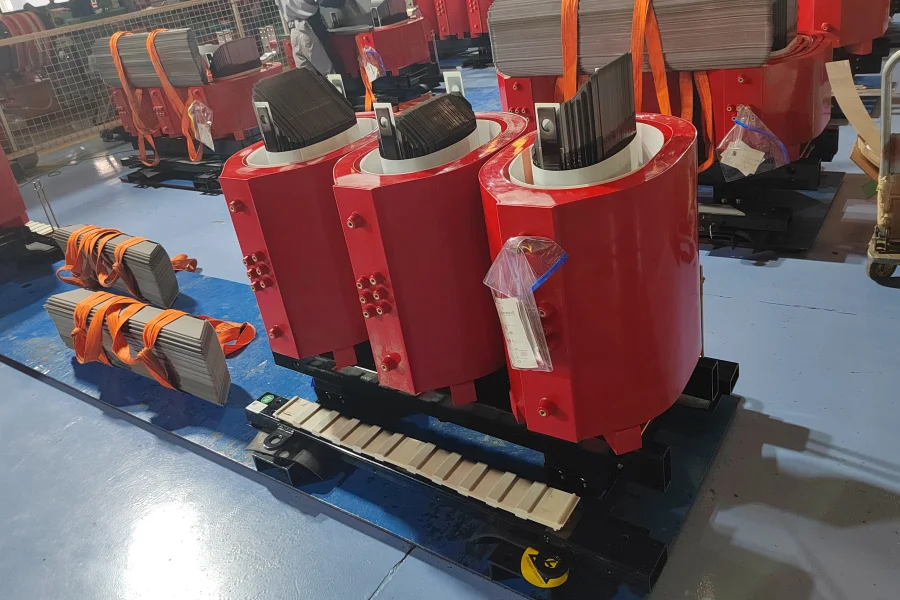
Dry-type transformers are commonly used in commercial buildings, industrial facilities, data centers, and other installations where oil-free equipment is preferred.
Depending on the application, designs may incorporate:
주조 수지 절연체
구리 또는 알루미늄 권선
AN or AN/AF cooling
Protective steel enclosures
Temperature monitoring
Customized impedance and voltage ratios
Enclosure protection ratings and fire-performance requirements should be confirmed for each project.
10.3 High-Voltage Power Transformers
High-voltage transformers require specialized engineering, manufacturing facilities, insulation systems, and testing capabilities.
Projects involving 110 kV, 220 kV, or higher voltage classes should undergo detailed technical review.
Relevant considerations include insulation coordination, short-circuit withstand capability, cooling performance, transportation limitations, and on-site installation requirements.
10.4 International Project Support
Evernew Transformer supports overseas customers by coordinating technical reviews, transformer manufacturing, inspection documentation, and export arrangements.
Project requirements may vary considerably by region.
For example, customers may require:
IEC-based transformer designs for international infrastructure projects
IEEE/ANSI configurations for North American applications
Country-specific energy-efficiency requirements
Special designs for high-altitude or high-temperature locations
Custom cable termination arrangements
Project-specific transportation and packing solutions
The applicable standards and guaranteed performance should always be confirmed in the technical agreement.
10.5 Factory Visits and Inspections
Factory inspections can help international buyers assess manufacturing capabilities and quality control processes.
Depending on project arrangements, buyers may request:
Factory tours
Production progress inspections
Witness testing
Review of quality documentation
Inspection before shipment
Factory visits and inspection arrangements should be scheduled in advance.
11. Frequently Asked Questions About Buying Power Transformers from China
How can I buy power transformers directly from a factory in China?
Start by preparing a technical RFQ that includes transformer capacity, voltage, frequency, vector group, cooling, applicable standards, quantity, and delivery destination. Contact a qualified manufacturer, review its technical proposal, verify manufacturing capability, and finalize the contract after confirming the specifications and commercial terms.
How do I verify a Chinese power transformer manufacturer?
Request the factory’s registration details, manufacturing address, production photographs, quality documentation, relevant test reports, and evidence of comparable projects. For major purchases, consider a factory visit or independent inspection.
Can Chinese power transformers comply with IEC and IEEE standards?
Yes. Chinese manufacturers can design and manufacture transformers to specified IEC or IEEE requirements when they have the necessary engineering and testing capabilities. Compliance must be evaluated against the applicable standard, edition, transformer configuration, and contractual requirements.
What information is required for a transformer quotation?
A transformer RFQ should include rated capacity, primary and secondary voltages, frequency, vector group, winding material, cooling method, impedance, tap changer requirements, applicable standards, installation conditions, quantity, and delivery location. Loss requirements and accessories should also be specified.
How long does it take to manufacture a power transformer in China?
Manufacturing lead time depends on transformer capacity, voltage class, design complexity, material availability, testing requirements, and factory workload. Standard distribution transformers may have shorter production schedules than customized high-voltage power transformers. Buyers should request a project-specific delivery schedule.
Is it cheaper to buy transformers directly from a Chinese factory?
Factory-direct sourcing may reduce intermediary costs and improve communication with engineering and production teams. However, the final price depends on technical specifications, raw materials, efficiency requirements, accessories, testing, and logistics. Buyers should compare the total landed cost rather than only the factory price.
What is the difference between EXW, FOB and CIF transformer prices?
EXW generally means the equipment is made available at the agreed factory location. FOB involves delivery on board a vessel at the named port, while CIF includes the seller arranging freight and specified insurance to the destination port. The precise obligations depend on the agreed Incoterms rule.
Can I inspect the transformer before shipment?
Yes, inspection can be arranged with the manufacturer subject to the purchase agreement. Buyers may review factory test reports, witness agreed tests, or appoint an independent inspection organization before shipment.
What documents should I receive with my transformer?
Depending on the contract, documentation may include the approved technical datasheet, GA drawings, factory test reports, nameplate information, operation and maintenance manuals, packing list, and relevant export documents.
Can Evernew Transformer manufacture customized power transformers?
Evernew Transformer works with manufacturing and engineering resources to support customized transformer requirements, including voltage ratios, winding configurations, cooling systems, enclosures, and accessories. Final feasibility, compliance, lead time, and pricing are confirmed through technical review.
12. Request a Power Transformer Quotation from China
Choosing the right power transformer manufacturer requires careful evaluation of technical specifications, manufacturing capabilities, testing arrangements, and total project costs.
A reliable procurement process should begin with a clear RFQ and continue through technical approval, production, factory testing, packing, and delivery.
For international buyers seeking customized power and distribution transformers, Evernew Transformer can assist with technical review and factory quotation coordination.
To request a quotation, please provide:
Transformer type and rated capacity
Primary and secondary voltages
Frequency and vector group
Applicable technical standards
Required cooling method and accessories
Quantity and delivery destination
Project specification or technical drawings, if available
에버뉴 트랜스포머에 문의
웹사이트: evernewtransformer.com
Our team can review your requirements and coordinate a suitable transformer proposal based on the project specifications.
