


How to Select the Right Model for Safety, Stability, and Long-Term Reliability
In industrial factories, electrical problems rarely appear as “power failures.”
They show up as unexpected shutdowns, control errors, equipment damage, or safety risks.
For this reason, isolation transformers are widely used in manufacturing plants, processing facilities, and industrial substations. However, many factories still select isolation transformers based on habit or price — not on actual electrical requirements.
This article explains how industrial factories should correctly choose isolation transformers, from a practical engineering and procurement perspective.
1. What an Isolation Transformer Really Does (Factory Perspective)
An isolation transformer is not simply a “special transformer.”
Its core function is:
To separate the factory’s electrical system from the supply side, reducing electrical interference and safety risks.
Key functions include:
-
Electrical isolation between input and output
-
Reduction of ground faults
-
Suppression of electrical noise and interference
-
Protection of sensitive industrial equipment
In most factories, isolation transformers are 1:1 ratio, meaning voltage remains unchanged while isolation is achieved.
2. Why Isolation Transformers Are Critical in Industrial Factories
Factories face electrical challenges that office buildings and residential systems do not:
-
High starting currents from motors
-
Frequent load changes
-
Harmonic distortion from drives and inverters
-
Sensitive PLCs, sensors, and control systems
Isolation transformers help address these issues by:
-
Preventing fault propagation
-
Stabilizing reference ground
-
Improving overall power quality
This makes them essential for production continuity and safety, not just compliance.
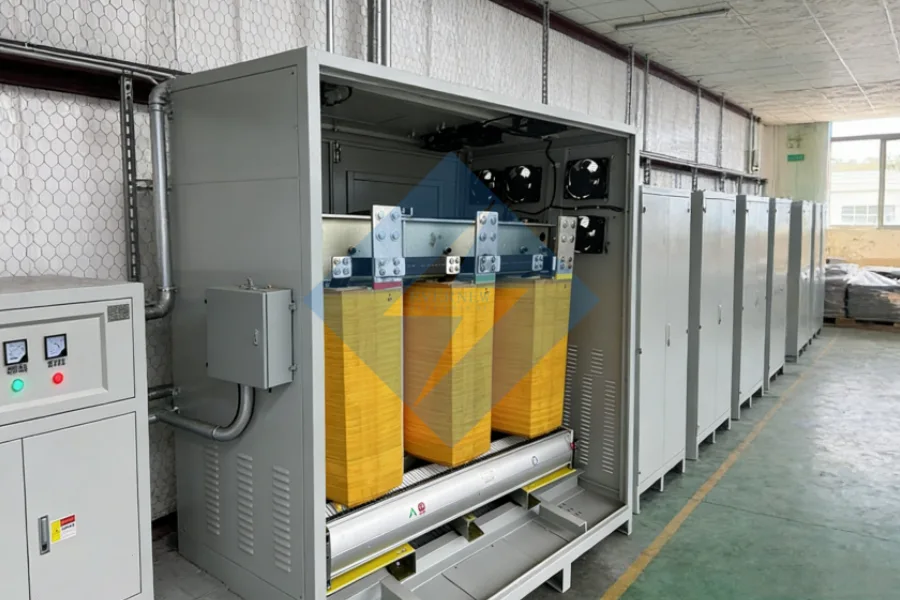
3. Common Industrial Applications of Isolation Transformers
Isolation transformers are typically installed in:
-
CNC machining centers
-
Automated production lines
-
PLC and control panels
-
Packaging and assembly systems
-
Chemical and pharmaceutical plants
-
Data-sensitive manufacturing processes
In these applications, stable control signals and noise-free power are more important than raw power capacity.
4. How to Choose the Right Isolation Transformer for a Factory
This is where many buyers make mistakes.
Below are the key selection criteria that actually matter in industrial environments.
4.1 Rated Capacity: Avoid Undersizing and Oversizing
Factory buyers often select capacity based only on connected load. This is risky.
Best practice:
-
Calculate total load
-
Add starting current margin
-
Reserve 20–30% capacity for future expansion
An undersized transformer causes overheating.
An oversized transformer wastes energy and space.
4.2 Voltage Configuration: Match Real Operating Conditions
Typical industrial voltages include:
-
380V / 400V / 415V
-
480V
-
220V / 230V
Ensure:
-
Input voltage matches factory supply
-
Output voltage matches equipment requirement
-
Neutral grounding strategy is clearly defined
Incorrect grounding defeats the purpose of isolation.
4.3 Insulation Class and Temperature Rise
Industrial environments are harsh:
-
High ambient temperature
-
Dust
-
Continuous operation
Choose transformers with:
-
클래스 F 또는 클래스 H 단열재
-
Conservative temperature rise design
This directly affects service life.
4.4 Shielding and Noise Suppression
For factories with:
-
VFDs
-
Inverters
-
Precision instruments
Electrostatic shielding between windings is strongly recommended.
This significantly reduces high-frequency noise transfer.
4.5 Cooling Method and Installation Space
Common options:
-
건식 유형 air-cooled (most factories)
-
Forced ventilation for high-load areas
Consider:
-
Installation location
-
Ventilation conditions
-
Maintenance access
Isolation transformers must dissipate heat reliably.
자세히 보기:덴마크의 해양 산업과 선박용 변압기: 해상에서 안정적인 전력 공급 보장

5. Compliance and Standards Matter More Than Brand Names
For industrial buyers, certification is not optional.
Common standards include:
-
IEC standards
-
IEEE references
-
Local electrical codes
A qualified manufacturer should provide:
-
Complete datasheets
-
Routine test reports
-
Clear drawings
-
Stable long-term support
6. Typical Mistakes Factories Make When Buying Isolation Transformers
Avoid these common errors:
-
Selecting only by kVA rating
-
Ignoring grounding method
-
Underestimating harmonic content
-
Choosing low-cost units with poor insulation
-
No consideration for future expansion
These mistakes lead to hidden costs and downtime.
7. Why Manufacturer Capability Matters
Isolation transformers may look simple — but industrial-grade units are not.
A capable manufacturer should have:
-
In-house core cutting and winding
-
Strict insulation process
-
Vacuum impregnation
-
Full routine testing
Factories should partner with manufacturers, not traders.
Buy Now:75 KVA 3 Phase Isolation Harmonic Mitigating Dry Type Transformer

8. Evernew Transformer: Supporting Industrial Power Stability
Evernew Transformer is a professional transformer manufacturer supplying industrial clients worldwide.
Our isolation transformers are designed for:
-
Continuous industrial operation
-
High insulation reliability
-
Low noise and stable performance
We support factories with:
-
Engineering-driven selection
-
맞춤형 전압 구성
-
Reliable delivery
-
Long-term technical support
9. Final Thoughts: Isolation Transformers Are a Strategic Decision
In industrial factories, isolation transformers are not accessories — they are infrastructure components.
The right selection improves:
-
Equipment reliability
-
Production continuity
-
Electrical safety
The wrong selection increases operational risk.
Looking for an Industrial Isolation Transformer?
If you are selecting isolation transformers for manufacturing plants, industrial substations, or automated production lines, Evernew Transformer can support your technical evaluation and project requirements.
📩 Contact us for datasheets, technical consultation, or quotation support.
