
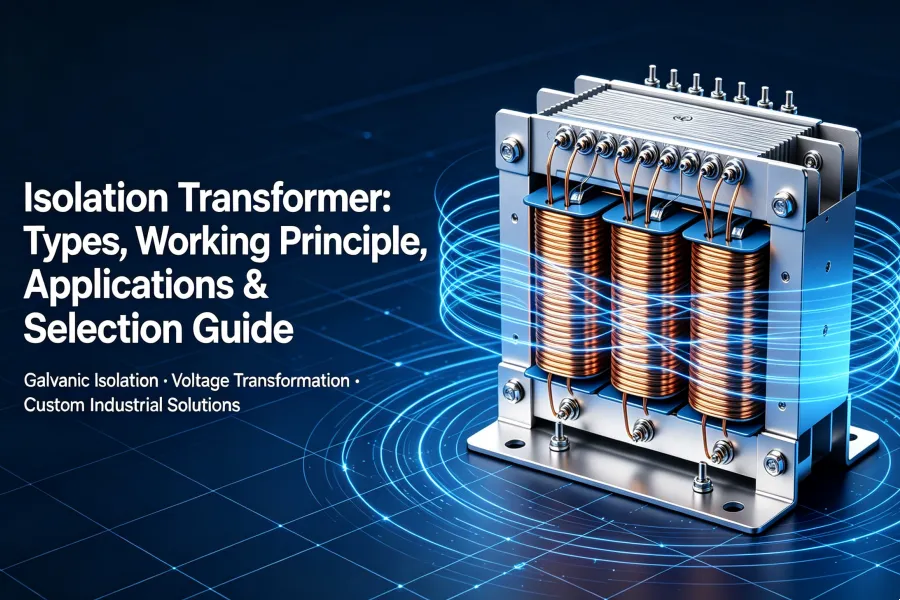
En isolationstransformator er en transformer, der er konstrueret til at adskille primærkredsløbet elektrisk fra sekundærkredsløbet, samtidig med at den overfører elektrisk energi via elektromagnetisk induktion. Da primær- og sekundærviklingerne ikke er elektrisk forbundet, kan en isolationstransformator ud over spændingstransformation også sikre galvanisk isolation.
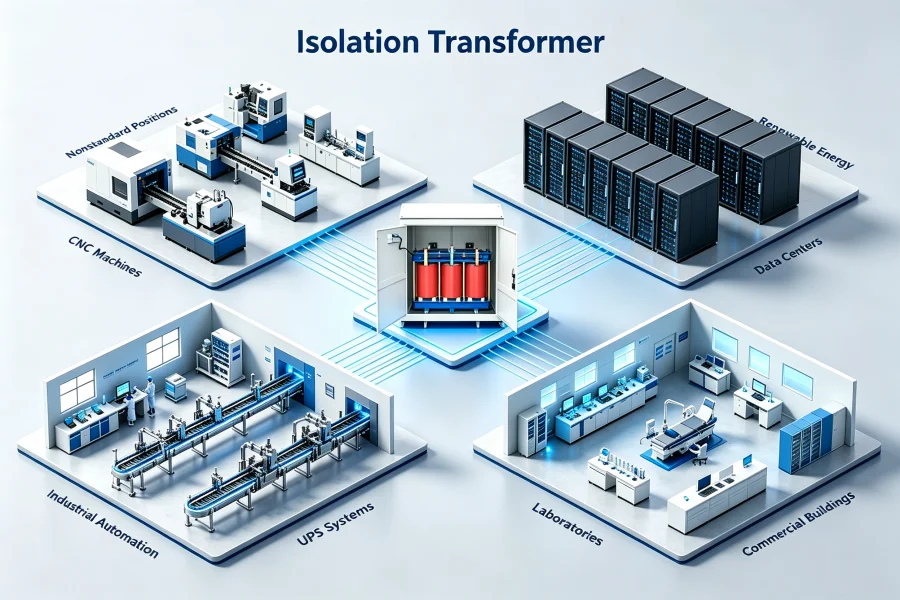
Isoleringstransformere anvendes i vid udstrækning i industrimaskiner, CNC-udstyr, hospitaler, datacentre, UPS-systemer, automatiseringsudstyr, laboratorier, erhvervsbygninger og andre anvendelsesområder, hvor elektrisk isolation og kontrolleret strømfordeling er af afgørende betydning.
Men ikke alle isolationstransformere er ens.
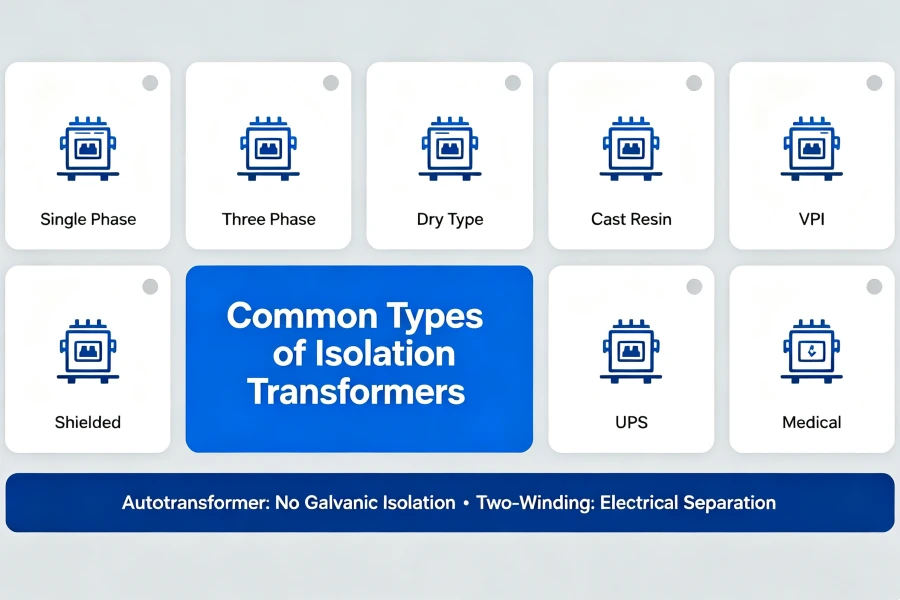
Afhængigt af anvendelsen kan det være nødvendigt med en enfaset isolationstransformator, trefaset isolationstransformator, tørtype isolationstransformator, isolationstransformator med støbt harpiks, VPI-transformator, afskærmet isolationstransformator eller en skræddersyet industriel isolationstransformator.
Denne vejledning beskriver de forskellige typer af isolationstransformere, hvordan de fungerer, deres anvendelsesområder, vigtige specifikationer, fordele samt hvordan man vælger den rigtige transformer til sit projekt.
Hvad er en isolationstransformator?
En isolationstransformator er en transformator med adskilte primær- og sekundærviklinger som ikke er elektrisk forbundet med hinanden.
Elektrisk energi overføres fra primærviklingen til sekundærviklingen via magnetfeltet i transformerkernen.
Ifølge Schneider Electric kan enhver transformer med to viklinger, hvor primær- og sekundærsiden ikke er elektrisk forbundet, betragtes som en isolationstransformer. Derimod har en autotransformer en elektrisk forbindelse mellem primær- og sekundærsiden.
For eksempel en transformer med:
- Nominel effekt: 75 kVA
- Primær spænding: 480 V
- Sekundær spænding: 208Y/120 V
- Fase: Tre faser
- Frekvens: 60 Hz
kan omforme spændingen fra 480 V til 208Y/120 V, samtidig med at den elektriske adskillelse mellem indgangs- og udgangskredsløbene opretholdes.
Kort sagt:
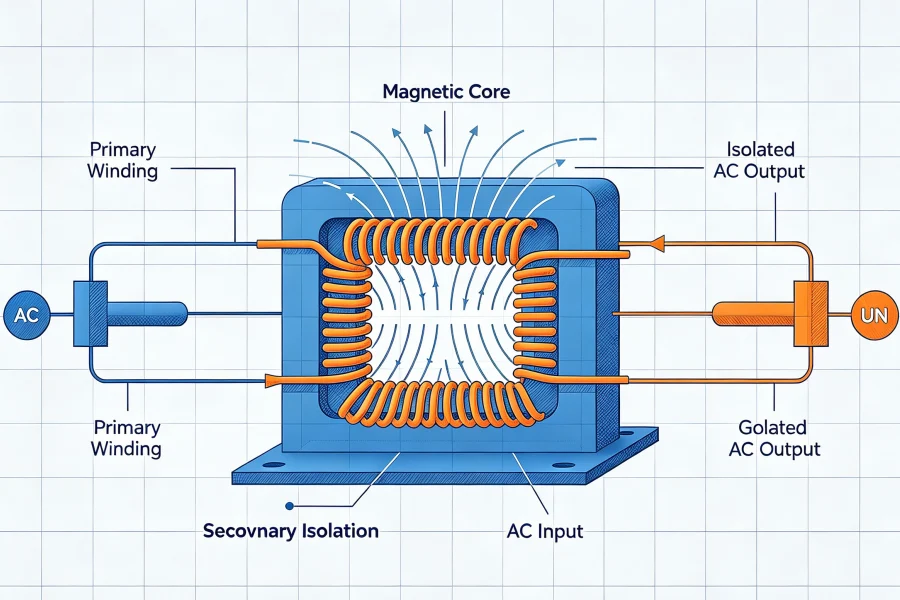
Vekselstrømsindgang → Primærvikling → Magnetkerne → Sekundærvikling → Isoleret vekselstrømsudgang
Isoleringen opstår, fordi der ikke er nogen direkte elektrisk forbindelse mellem primær- og sekundærviklingerne.
Hvordan fungerer en isolationstransformator?
En isolationstransformator fungerer efter princippet om elektromagnetisk induktion.
Når der tilføres vekselstrøm til primærviklingen, frembringer den en vekslende magnetisk flux i transformerkernen. Denne skiftende magnetiske flux inducerer en spænding i sekundærviklingen.
Da de to viklinger er elektrisk uafhængige af hinanden, overføres strømmen magnetisk i stedet for via en direkte elektrisk forbindelse.
Spændingsforholdet bestemmes omtrent af viklingsforholdet:
V₁ / V₂ ≈ N₁ / N₂
Hvor?
- V₁ = primærspænding
- V₂ = secondary voltage
- N₁ = primary turns
- N₂ = secondary turns
An isolation transformer can therefore be designed for:
- Step-down voltage conversion
- Step-up voltage conversion
- 1:1 voltage isolation
A 1:1 isolation transformer, for example, may have approximately the same primary and secondary voltage while providing galvanic isolation.
Hvad gør en isolationstransformator?
The main function of an isolation transformer is to electrically separate the primary and secondary circuits.
Depending on the design and installation, an isolation transformer can also be used to:
1. Sørg for galvanisk adskillelse
The separate windings prevent a direct conductive path between the source and load.
2. Spændingsændring
An isolation transformer can step voltage up or down.
Examples include:
- 480 V → 208 V
- 480 V → 240 V
- 600 V → 480 V
- 400 V → 230 V
- 380 V → 220 V
3. Bidrager til at mindske visse elektriske forstyrrelser
Isolation transformers can help limit the transfer of certain common-mode disturbances between the primary and secondary systems. The actual result depends on transformer construction, grounding, shielding, system impedance, and the overall electrical installation.
4. Støtte til følsomt udstyr
Isolation transformers can be incorporated into power systems serving sensitive electronic and industrial equipment.
5. Tilvejebring et separat udviklet system
Depending on the electrical design and applicable code, the secondary can be grounded and bonded to establish a separately derived system.
Typer af isolationstransformatorer
There are several ways to classify isolation transformers.
They can be categorized according to:
- Fase
- Insulation system
- Konstruktion
- Anvendelse
- Køling
- Spænding
- Indkapsling
- Shielding
The most common types include the following.
1. Enfaset isolationstransformator
A single phase isolation transformer is designed for single-phase electrical systems.
It is commonly used for relatively small loads and individual electrical equipment.
Typiske anvendelsesområder
- CNC machines
- Machine tools
- Styresystemer
- Laboratory equipment
- Electronic equipment
- Belysning
- Industrial automation
- Test equipment
Common ratings may include:
- 500 VA
- 1 kVA
- 2 kVA
- 5 kVA
- 10 kVA
- 15 kVA
- 25 kVA
- 50 kVA
The exact capacity and voltage ratio should be selected according to the connected load and application.
2. Trefaset isolationstransformator
A three phase isolation transformer is designed for three-phase industrial and commercial power systems.
It is one of the most important isolation transformer types for industrial projects.
Typiske anvendelsesområder
- Manufacturing plants
- Industrimaskiner
- Datacentre
- UPS-systemer
- Hospitaler
- Automatiseringssystemer
- Vedvarende energisystemer
- Kommercielle bygninger
- Minedrift
- Oil and gas facilities
Typical voltage combinations include:
| PRIMARY VOLTAGE | SECONDARY VOLTAGE |
|---|---|
| 380 V | 220 V |
| 400 V | 230 V |
| 415 V | 400 V |
| 480 V | 208Y/120 V |
| 480 V | 240 V |
| 600 V | 480 V |
| 690 V | 400 V |
The transformer can be designed with different winding connections and vector groups depending on system requirements.
3. Tørtype-adskillelsestransformator
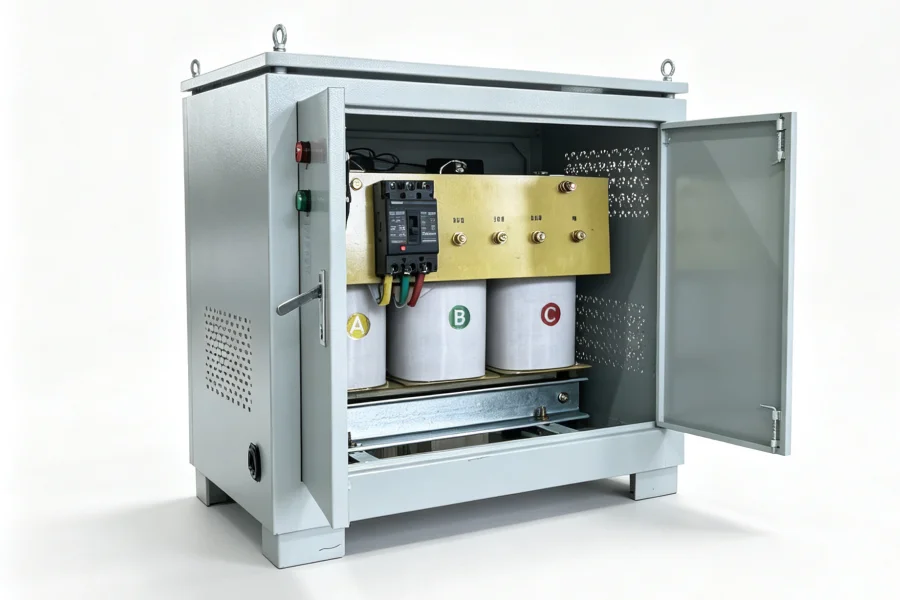
A tørtype-adskillelsestransformator uses solid insulation and air rather than liquid insulating oil.
Dry type construction is particularly attractive for indoor installations where oil containment, fire protection, or environmental considerations are important.
Dry-type transformers can be designed in different constructions, including encapsulated, cast resin, and other ventilated or enclosed designs. IEC 61558-1 covers safety requirements for various dry-type transformers, including both encapsulated and non-encapsulated windings, for applications within its scope.
Fordele ved tørisolerede transformere
- No insulating oil
- Low maintenance
- Suitable for many indoor installations
- Reduced risk of oil leakage
- Compact installation
- Good environmental compatibility
Typiske anvendelsesområder
- Kommercielle bygninger
- Hospitaler
- Datacentre
- Fabrikker
- Schools
- Lufthavne
- Metro systems
- Industrianlæg
4. Isolationstransformator af støbt harpiks
A cast resin isolation transformer uses epoxy resin to encapsulate the windings.
The encapsulation provides additional protection against moisture, dust, and environmental contamination.
Fordele
- Excellent moisture resistance
- High mechanical strength
- Low maintenance
- Good fire performance
- Suitable for indoor environments
- Good resistance to environmental contamination
Cast resin dry-type transformer technology is widely used for demanding indoor and industrial applications. ABB, for example, offers cast-resin dry-type transformers for industrial and infrastructure applications.
Typiske anvendelsesområder
- Hospitaler
- Datacentre
- Lufthavne
- Shoppingcentre
- Metro stations
- Industrianlæg
- Projekter inden for vedvarende energi
5. VPI-isolationstransformator
VPI stands for Vacuum Pressure Impregnated.
In a VPI transformer, insulating varnish is impregnated into the winding insulation system under vacuum and pressure.
VPI construction is widely used for industrial dry-type transformer applications where mechanical strength, thermal performance, and environmental resistance are important.
Typiske anvendelsesområder
- Industrielle fabrikker
- Minedrift
- Stålværker
- Oil and gas
- Industrial drives
- UPS-systemer
- Renewable energy
When selecting between VPI and cast resin, the decision should consider the installation environment, voltage, capacity, cooling requirements, maintenance expectations, and project specifications.
6. Afskærmet isolationstransformator
A shielded isolation transformer includes an electrostatic shield between the primary and secondary windings.
The shield can help reduce the transfer of certain high-frequency electrical disturbances.
However, an important point for buyers is that the word “isolation” does not automatically mean the transformer includes an electrostatic shield. If shielding is required, it should be explicitly specified in the transformer technical specification. Schneider Electric also makes this distinction in its technical guidance.
Typiske anvendelsesområder
- Datacentre
- Laboratories
- Medical equipment
- Precision electronics
- Communication systems
- Measurement equipment
- Sensitive industrial controls
7. Industriel isolationstransformator
En industrial isolation transformer is designed for demanding industrial applications.
Compared with small control transformers, industrial isolation transformers may have much higher capacities and customized electrical characteristics.
Typiske anvendelsesområder
- CNC machinery
- Manufacturing lines
- Motors and drives
- Industrial automation
- Welding equipment
- Mining equipment
- Oil and gas
- Steel mills
- Heavy industry
Industrial projects may require customized:
- Impedans
- Spændingsforhold
- Vektorgruppe
- Haner
- Harmonic performance
- Shielding
- Indkapsling
- Køling
- Kortslutningsmodstand
8. Isolationstransformator til UPS-systemer
Isolation transformers are frequently incorporated into certain UPS and critical power architectures.
They can be used for:
- Voltage conversion
- Electrical isolation
- System grounding configuration
- Separation of electrical circuits
Typiske anvendelsesområder omfatter:
- Datacentre
- Telecom facilities
- Server rooms
- Industrial UPS
- Battery systems
- Critical infrastructure
The exact transformer configuration must be coordinated with the UPS manufacturer and the overall electrical system.
9. Medicinsk isolationstransformator
Medical electrical systems have special safety requirements, so medical isolation transformers should not be selected simply based on capacity and voltage.
Depending on the application, medical transformers may need to satisfy additional requirements concerning:
- Leakage current
- Isolering
- Monitoring
- Shielding
- Beskyttelse
- Temperatur
- Medical IT systems
Different transformer standards apply to different medical and equipment-transformer applications. For example, IEC 61558 contains specific parts covering safety transformers and particular applications.
For medical projects, the transformer specification should always be reviewed against the applicable local electrical and medical standards.
Anvendelser af isolationstransformatorer
Isolation transformers are used across a wide range of industries.
| APPLICATION | TYPICAL PURPOSE |
|---|---|
| CNC Machines | Voltage conversion and electrical isolation |
| Datacentre | Critical power distribution |
| Hospitaler | Specialized electrical systems |
| Industrial Automation | Isolated power for equipment |
| UPS Systems | Voltage conversion and isolation |
| Laboratories | Controlled power supply |
| Produktion | Equipment power distribution |
| Vedvarende energi | Electrical separation and voltage conversion |
| Marine Systems | Specialized power distribution |
| Kommercielle bygninger | Voltage transformation and isolation |
Isoleringstransformator til CNC-maskiner
CNC equipment can be sensitive to voltage quality, electrical disturbances, and grounding conditions.
An appropriately specified isolation transformer can provide:
- Voltage transformation
- Galvanic isolation
- Power-system separation
- Reduced transfer of certain common-mode disturbances
Blandt de mest almindelige konfigurationer kan nævnes:
480 V → 240 V
480 V → 208 V
400 V → 230 V
380 V → 220 V
For CNC applications, the transformer should also be evaluated for starting current, inrush current, harmonics, load characteristics, and required capacity.
Isoleringstransformator til datacentre
Data centers require highly reliable electrical infrastructure.
Isolation transformers may be used as part of the power distribution architecture for:
- UPS-systemer
- PDUs
- Server equipment
- Critical loads
- Electrical distribution
Common North American configurations include:
480 V → 208Y/120 V
480 V → 480Y/277 V
600 V → 480 V
The appropriate configuration depends on the facility’s electrical distribution system.
Isoleringstransformator til industrielt udstyr
Industrial equipment can have very different electrical characteristics from standard commercial loads.
Examples include:
- Variable-frequency drives
- Rectifiers
- Welding equipment
- CNC machines
- Motorer
- PLC systems
- Automated production lines
These loads can generate harmonics, inrush current, or rapid changes in current.
Therefore, selecting an isolation transformer based only on the nameplate kVA may not be sufficient.
The transformer manufacturer should review the actual load characteristics.
Isoleringstransformator kontra autotransformator
This is one of the most frequently misunderstood topics.
| SPECIALARTIKEL | ISOLATION TRANSFORMER | AUTOTRANSFORMER |
|---|---|---|
| Primærvikling | Separate | Common winding section |
| Sekundærvikling | Separate | Common winding section |
| Galvanic isolation | Yes | No |
| Direct electrical connection | No | Yes |
| Voltage conversion | Yes | Yes |
| Størrelse | Generally larger | Generally smaller |
| Omkostninger | Generelt højere | Generally lower |
| Typical use | Isolation and voltage conversion | Efficient voltage adjustment |
An autotransformer has a common portion of the winding between primary and secondary circuits, so it does not provide galvanic isolation.
Vigtigt:
If your project specifically requires electrical isolation, do not replace a two-winding isolation transformer with an autotransformer simply because the voltage ratio is the same.
Isoleringstransformator kontra almindelig transformator
The term “isolation transformer” can sometimes cause confusion.
A two-winding transformer with electrically separate primary and secondary windings already provides electrical isolation.
Therefore, the distinction is often based on the intended function and specification, rather than a completely different transformer principle.
For example, a conventional two-winding dry-type distribution transformer can provide electrical isolation, while an autotransformer cannot.
An isolation transformer project may additionally specify:
- 1:1 voltage ratio
- Electrostatic shield
- Special insulation
- Low leakage requirements
- Noise attenuation
- Specific grounding arrangement
- Special enclosure
These requirements must be clearly defined in the technical specification.
Isoleringstransformator kontra transformator: De vigtigste forskelle
| SPECIALARTIKEL | ISOLATION TRANSFORMER | GENERAL TWO-WINDING TRANSFORMER |
|---|---|---|
| Separate windings | Yes | Yes |
| Galvanic isolation | Yes | Yes |
| Voltage transformation | Valgfrit | Common |
| 1:1 ratio | Common in some applications | Less common |
| Shield | Valgfrit | Valgfrit |
| Noise attenuation | Can be designed for it | Depends on design |
| Main purpose | Isolation + power transfer | Voltage transformation/distribution |
The key point is that not every isolation transformer is a completely separate category of transformer construction.
Tørtype kontra oliefyldt isolationstransformator
Isolation transformers can be manufactured using different insulation and cooling technologies.
| SPECIALARTIKEL | DRY TYPE | OIL FILLED |
|---|---|---|
| Insulating medium | Air / solid insulation | Insulating oil |
| Indendørs installation | Excellent for many applications | Application dependent |
| Oil leakage | None | Possible |
| Fire considerations | Generally favorable | Requires appropriate fire/safety provisions |
| Vedligeholdelse | Generally low | Oil inspection/testing may be required |
| Typical application | Commercial/industrial indoor systems | Larger outdoor systems |
| Environmental considerations | No insulating oil | Requires oil management |
Transformatorer af tør type are especially attractive where the transformer must be located close to the load or inside buildings. ABB highlights the absence of insulating oil and the resulting installation and environmental advantages of dry-type technology.
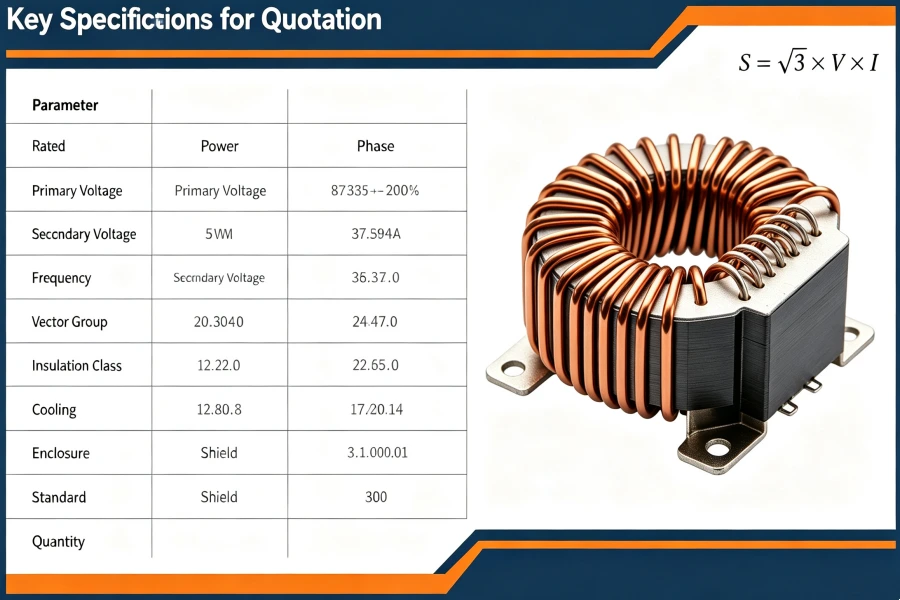
Vigtige specifikationer for isolationstransformatorer
When requesting an isolation transformer quotation, providing the correct technical information can significantly reduce quotation time.
The most important parameters include:
| PARAMETER | EXAMPLE |
|---|---|
| Nominel effekt | 75 kVA |
| Fase | Tre faser |
| Primær spænding | 480 V |
| Sekundær spænding | 208Y/120 V |
| Frekvens | 60 Hz |
| Viklingsmateriale | Kobber |
| Vector-gruppen | Dyn11 |
| Isoleringsklasse | F / H |
| Køling | AN / AF |
| Impedans | According to design |
| Indkapsling | IP00 / IP20 / IP23 / IP54 |
| Electrostatic Shield | Yes / No |
| Installation | Indendørs/udendørs |
| Standard | IEC / ANSI / UL / CSA |
| Tap | ±2 × 2.5%, if required |
| Mængde | Project quantity |
Hvilken størrelse isolationstransformator skal jeg bruge?
The correct transformer capacity depends on the actual electrical load.
For a three-phase system:
S = √3 × V × I
Hvor?
- S = apparent power
- V = line-to-line voltage
- I = line current
However, simply calculating the connected load is not always enough.
The transformer selection should also consider:
- Motor starting current
- Transformer inrush
- Load diversity
- Harmonics
- Nonlinear loads
- Ambient temperature
- Future load expansion
- Continuous loading
- Required overload capability
Eksempel
Suppose an industrial system requires approximately 60 kVA of continuous apparent power.
A 75 kVA transformer may be considered, depending on the actual load characteristics and required margin.
For a large industrial installation, the manufacturer should review the complete load profile before finalizing the rating.
Sådan vælger du den rigtige isolationstransformator
Trin 1: Bestem den nominelle kapacitet
Determine:
- Connected load
- Maximum demand
- Motor starting requirements
- Future expansion
- Continuous operating load
Trin 2: Bekræft primærspændingen
Common values include:
- 208 V
- 220 V
- 230 V
- 240 V
- 380 V
- 400 V
- 415 V
- 440 V
- 480 V
- 600 V
Trin 3: Bekræft sekundærspændingen
Typical secondary voltages include:
- 120 V
- 208Y/120 V
- 220 V
- 230 V
- 240 V
- 400 V
- 415 V
- 480 V
Trin 4: Vælg enfaset eller trefaset
Vælg enfaset til:
- Small equipment
- Styrekredsløb
- Laboratory equipment
- Individual machinery
Vælg trefaset til:
- Industrianlæg
- Large machinery
- Datacentre
- Kommercielle bygninger
- Industrial distribution
Trin 5: Vælg isoleringssystemet
Depending on the application, you may select:
- Open ventilated
- Encapsulated
- Støbt harpiks
- VPI
The installation environment and project standards should determine the final selection.
Trin 6: Vælg kabinettet
For an indoor clean electrical room, an open or ventilated design may be appropriate.
For environments containing:
- Dust
- Moisture
- Dirt
- Chemical contamination
- Wash-down conditions
a suitable enclosed design may be required.
For example, enclosed dry-type transformers are available for environments where conventional ventilation openings are unsuitable.
Standarder for isolationstransformatorer
The applicable standard depends on the transformer type, voltage, capacity, application, and target market.
Commonly referenced standards include:
IEC
IEC 60076 series
For power transformer applications within its scope.
IEC 61558
IEC 61558 addresses safety requirements for transformers, reactors, power supply units, and related equipment. IEC 61558-1:2017 is the general requirements and tests standard within the series.
Nordamerika
Depending on the application, project specifications may reference:
- UL
- CSA
- ANSI
- IEEE
- NEMA
The exact applicable standard should always be confirmed from the project specification rather than assuming one standard applies to every isolation transformer.
Prøvning af isolationstransformatorer
Before shipment, transformers may undergo routine tests according to the applicable product standard and project specification.
Typical transformer tests can include:
- Winding resistance
- Spændingsforhold
- Polarity / phase displacement
- Tab uden belastning
- No-load current
- Impedans
- Applied voltage test
- Induced voltage test
- Insulation resistance
- Partial discharge, when specified
- Temperature-rise or type tests, when required
The exact test program depends on the transformer design, standard, rating, and customer requirements.
For an EPC project, the buyer should specify whether routine test reports, type-test certificates, or third-party inspection are required.
Hvor længe holder en isolationstransformator?
A properly designed, manufactured, installed, and maintained isolation transformer can provide many years of reliable service.
Actual service life depends on:
- Driftstemperatur
- Load level
- Insulation system
- Harmonic content
- Ambient conditions
- Ventilation
- Vedligeholdelse
- Short-circuit events
- Installation quality
For this reason, transformer life should not be determined by a single fixed number of years.
Fordelene ved en isolationstransformator
Elektrisk isolering
The primary and secondary circuits are electrically separated.
Spændingstransformation
The transformer can change voltage while maintaining isolation.
Fleksibelt design
Isolation transformers can be customized for different:
- Voltages
- Capacities
- Frequencies
- Phase configurations
- Vektorgrupper
- Enclosures
- Cooling methods
Begrænset overførsel af visse forstyrrelser
With appropriate design, shielding, grounding, and system configuration, an isolation transformer can reduce the transfer of certain common-mode electrical disturbances.
Velegnet til følsomme laster
They can be incorporated into power systems serving sensitive industrial and electronic equipment.
Hvad er en elektrostatisk afskærmning?
An electrostatic shield is a conductive layer installed between the primary and secondary windings.
It can provide additional attenuation of certain capacitive/common-mode noise paths when correctly designed and grounded.
However:
An isolation transformer does not automatically include an electrostatic shield.
If your application requires shielding, specify it separately in the RFQ.
This is particularly important for:
- Datacentre
- Laboratories
- Medical equipment
- Precision instruments
- Audio systems
- Følsomt elektronisk udstyr
Schneider Electric explicitly notes that “isolation” does not itself imply the presence of an electrostatic shield.
Isoleringstransformator til 480 V til 208 V
480V to 208V isolation transformers are a particularly common configuration in North American commercial and industrial electrical systems.
A typical specification may look like:
75 kVA Three Phase Isolation Transformer
- Primary: 480 V
- Secondary: 208Y/120 V
- Frequency: 60 Hz
- Winding: Copper
- Cooling: AN
- Insulation: Class H
- Vector Group: Dyn11
- Shield: Optional
- Enclosure: Indoor/outdoor as required
The final specification should be coordinated with the electrical distribution system and applicable project requirements.
Producent af isolationstransformere
Hvorfor vælge EverNew Transformer?
EverNew Transformer is a professional transformer manufacturer in China providing customized transformer solutions for industrial, commercial, renewable-energy, and infrastructure projects.
Our engineering team can design isolation transformers according to customer requirements, including voltage, capacity, frequency, phase, winding material, insulation system, cooling method, enclosure, and applicable standards.
Vores kompetencer omfatter:
- Single-phase isolation transformers
- Three-phase isolation transformers
- Dry type isolation transformers
- Cast resin transformers
- VPI transformers
- Shielded isolation transformers
- Industrial isolation transformers
- Control transformers
- Custom voltage ratios
- OEM / ODM transformer manufacturing
Skræddersyet produktion
We can customize:
Nominel effekt: according to project requirements
Primær spænding: customized
Sekundær spænding: customized
Frekvens: 50 Hz / 60 Hz
Fase: single-phase / three-phase
Snoede sig: copper / aluminum
Køling: AN / AF
Insulation: according to design
Enclosure: customized
Standarder: according to target market and project specification
Hvorfor købe en isolationstransformator direkte fra producenten?
Working directly with a transformer manufacturer can be particularly useful for EPC contractors, electrical distributors, system integrators, and industrial users requiring customized specifications.
A manufacturer can support:
Teknisk udformning
Review your single-line diagram, datasheet, or technical specification.
Skræddersyet produktion
Adapt:
- Spænding
- Kapacitet
- Vektorgruppe
- Impedans
- Haner
- Indkapsling
- Køling
- Shielding
Fabriksprøvning
Provide routine test reports and other documentation required by the project.
OEM-tjenester
Manufacture transformers according to customer drawings, specifications, or branding requirements.
Eksportstøtte
Support international packaging, documentation, and shipping for overseas projects.
Sådan bestiller du en isolationstransformator
If you are requesting a quotation, providing the following information will help the manufacturer respond quickly.
Angiv venligst:
- Rated capacity (kVA)
- Primær spænding
- Sekundær spænding
- Single phase or three phase
- Frekvens
- Viklingsmateriale
- Indoor or outdoor installation
- Required standard
- Mængde
- Delivery destination
If you already have a technical specification, BOQ, drawing, or datasheet, simply send it to the manufacturer.
Our engineers can review the technical requirements and recommend a suitable isolation transformer.
Ofte stillede spørgsmål om isolationstransformere
Hvad er en isolationstransformator?
An isolation transformer is a transformer with separate primary and secondary windings that provides galvanic isolation between the input and output circuits.
Hvad er hovedformålet med en isolationstransformator?
Its primary function is electrical isolation. It can also provide voltage transformation and, depending on its design and system configuration, help limit the transfer of certain electrical disturbances.
Hvad er forskellen mellem en isolationstransformator og en autotransformator?
An isolation transformer uses separate primary and secondary windings, while an autotransformer has a common electrical connection between the input and output windings. Therefore, an autotransformer does not provide galvanic isolation.
Kan en isolationstransformator ændre spændingen?
Yes. An isolation transformer can be designed as a step-up, step-down, or approximately 1:1 transformer.
Hvad er en 1:1-isolationstransformator?
A 1:1 isolation transformer has approximately equal primary and secondary voltage ratings while maintaining electrical isolation between the two circuits.
Hvad er en trefaset isolationstransformator?
It is an isolation transformer designed for a three-phase electrical system, commonly used in industrial and commercial applications.
Er isolationstransformatorer af den tørre type?
Many isolation transformers are dry type, particularly those used for indoor industrial, commercial, electronic, and specialized applications.
Reducerer en isolationstransformator elektrisk støj?
It can help reduce the transfer of certain common-mode disturbances. The effectiveness depends on transformer construction, shielding, grounding, and the overall electrical system.
Har alle isolationstransformatorer en elektrostatisk afskærmning?
No. An electrostatic shield must normally be specifically requested when required by the application.
Kan en isolationstransformator tilpasses efter behov?
Yes. Manufacturers can customize capacity, primary and secondary voltage, frequency, phase, winding material, impedance, vector group, cooling, enclosure, shielding, and other requirements.
Hvordan vælger jeg den rigtige isolationstransformator?
Start with the required capacity, input voltage, output voltage, phase, frequency, installation environment, applicable standards, and load characteristics. For industrial or critical applications, provide the complete technical specification to the transformer manufacturer.
Anmod om et tilbud på en isolationstransformator
Leder du efter en pålidelig producent af isolationstransformere?
Whether you need a small single-phase isolation transformer, a three-phase dry type isolation transformer, a 480V to 208V isolation transformer, or a customized industrial transformer, EverNew Transformer can provide a solution based on your project requirements.
Send us your transformer specification, datasheet, BOQ, or project requirements.
Our engineering team can help you confirm:
- Transformer capacity
- Primær- og sekundærspænding
- Phase configuration
- Vektorgruppe
- Insulation system
- Afkølingsmetode
- Indkapsling
- Elektrostatisk afskærmning
- Gældende standarder
- Testkrav
- Production and delivery requirements
Anmod om et tilbud fra EverNew Transformer
Contact us today for a customized isolation transformer solution and competitive quotation.
