


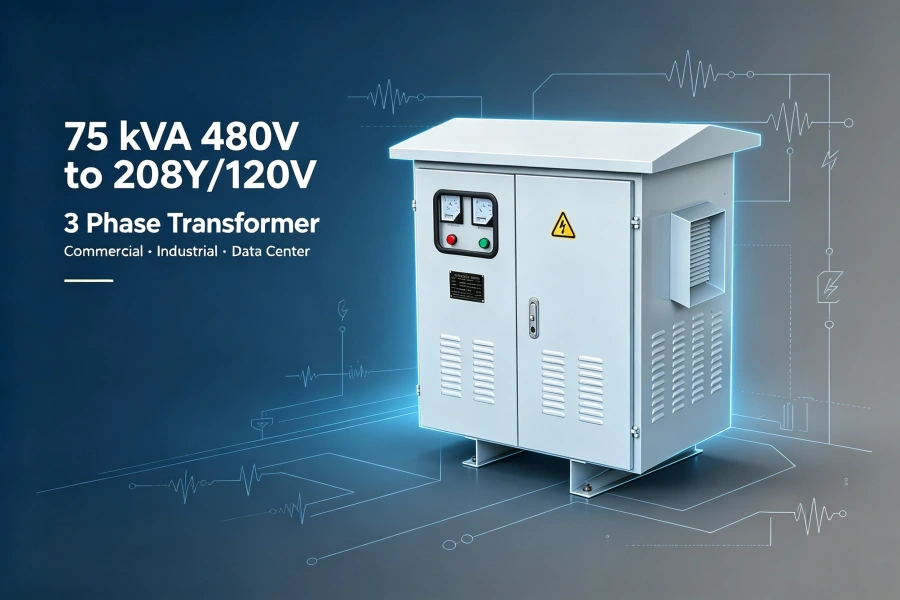
A 75 kVA 480-208Y/120 volt 3 phase transformer is a commonly used low-voltage dry-type distribution transformer for commercial buildings, industrial facilities, data centers, manufacturing plants, and other electrical systems that require both 208V three-phase power and 120V single-phase power.
This transformer steps down a 480V three-phase electrical supply to a 208Y/120V secondary system, making it possible to supply three-phase equipment while also providing 120V power for lighting, receptacles, controls, and other single-phase loads.
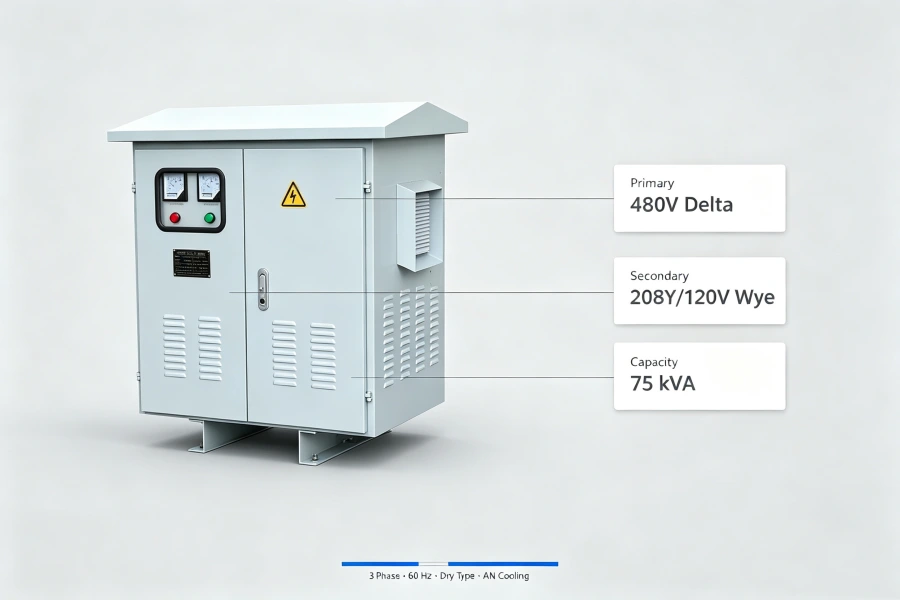
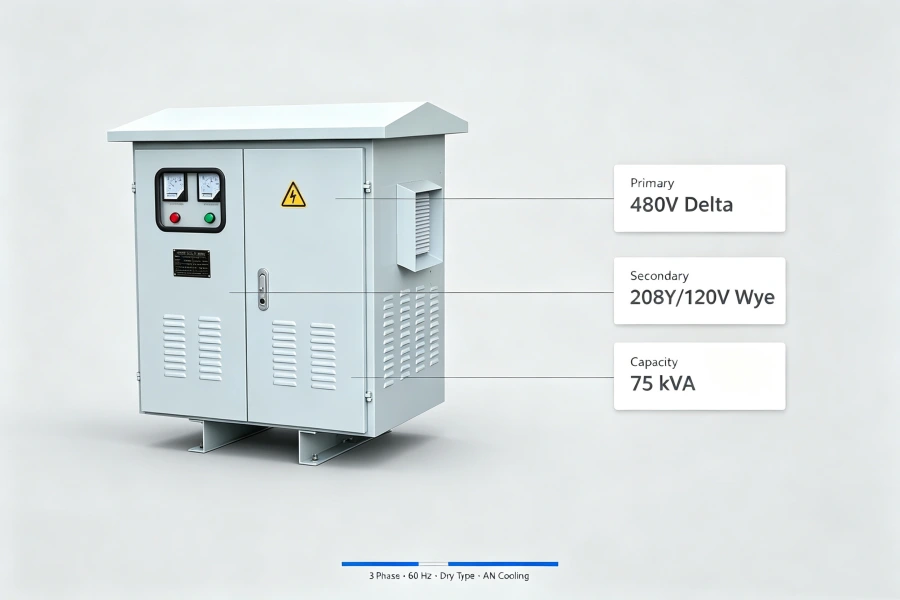
For projects in the United States and Canada, common specifications include a 60 Hz frequency, 480V delta primary, 208Y/120V grounded-wye secondary, dry-type construction, and NEMA-rated enclosures. Commercial products from major manufacturers such as Schneider Electric, Acme Electric, Siemens, and Eaton use this voltage configuration.
What Is a 75 kVA 480V to 208Y/120V Transformer?
A 75 kVA transformer has a rated apparent power of 75 kilovolt-amperes (kVA).
The typical voltage configuration is:
- Primary voltage: 480V
- Secondary voltage: 208Y/120V
- 阶段: 三相
- 频率 60 赫兹
- Rated capacity: 75 千伏安
- Transformer type: Dry type
- 冷却 AN (air natural)
- Secondary connection: Wye with neutral
- Typical application: Low-voltage power distribution
The term 208Y/120V means that the secondary winding is connected in a wye configuration. The voltage between any two phases is 208V, while the voltage between any phase and the neutral point is 120V.
This makes the transformer particularly useful when a facility has both 208V three-phase loads and 120V single-phase loads.
75 kVA Transformer Full Load Current
One of the most important specifications when selecting a transformer is its full-load current.
For a three-phase transformer, the approximate full-load current can be calculated using:
I = kVA × 1,000 / (√3 × V)
Primary current
For a 75 kVA transformer with a 480V primary:
75,000 / (1.732 × 480) ≈ 90.2 A
Therefore, the primary full-load current is approximately:
90 A
Secondary current
For the 208V secondary:
75,000 / (1.732 × 208) ≈ 208.2 A
Therefore, the secondary full-load current is approximately:
208 A
Manufacturer specifications for comparable 75 kVA Isolation transformers also show approximately 90.2A primary current and 208.2A secondary current.
| PARAMETER | TYPICAL VALUE |
|---|---|
| 额定功率 | 75 千伏安 |
| 初级电压 | 480V |
| 二次电压 | 208Y/120V |
| Primary Full-Load Current | ≈ 90.2 A |
| Secondary Full-Load Current | ≈ 208.2 A |
| 阶段 | 3 Phase |
| 频率 | 60 赫兹 |
Actual conductor, breaker, disconnect, and overcurrent protection requirements should always be determined according to the applicable electrical code and the complete installation design.
Why Use 480V to 208Y/120V?
480V is widely used for electrical distribution in North American commercial and industrial facilities because higher distribution voltage can reduce current and voltage drop.
However, many facility loads require lower voltages.
A 208Y/120V system provides:
208V three-phase power for:
- 馬達
- HVAC equipment
- Pumps
- Industrial machinery
- Commercial equipment
and:
120V single-phase power for:
- Lighting
- Receptacles
- Control circuits
- Office equipment
- Small electrical appliances
A single 480V-to-208Y/120V transformer can therefore serve multiple types of loads within the same facility.
Typical Applications
1. Commercial Buildings
75 kVA transformers can be used in office buildings, retail facilities, hotels, and commercial complexes to supply 208Y/120V distribution systems.
2. Industrial Facilities
Manufacturing plants frequently use 480V for larger motors and equipment while requiring 208Y/120V for auxiliary systems, controls, lighting, and general-purpose loads.
3. Data Centers
208Y/120V distribution is commonly used for certain data center loads, IT equipment, auxiliary systems, and facility infrastructure.
For data center applications, transformer selection may require additional consideration of harmonic currents, K-factor requirements, impedance, temperature rise, redundancy, and power quality.
4. Schools and Institutions
Schools, universities, hospitals, and other institutional buildings can use 480V-to-208Y/120V transformers to supply mixed electrical loads.
5. Retail and Service Facilities
Shopping centers, restaurants, workshops, and service facilities may require both 208V three-phase and 120V single-phase power.
Delta Primary vs. Wye Primary
A common configuration for this transformer is:
480V Delta Primary → 208Y/120V Secondary
Major manufacturers offer 75 kVA products with this configuration. For example, Schneider Electric lists a 75 kVA three-phase dry-type transformer with a 480V delta primary and 208Y/120V secondary.
However, a 480V wye primary configuration is also possible for certain applications.
The correct primary connection depends on the facility’s incoming electrical system.
Therefore, buyers should specify not only the voltage but also the required primary connection.
Copper or Aluminum Windings?
Both copper and aluminum winding materials can be used for a 75 kVA dry-type transformer.
铜绕组
Copper offers excellent electrical conductivity and can provide a compact winding design.
Copper-wound transformers are often selected when:
- Space is limited
- High mechanical strength is required
- Lower winding resistance is preferred
- The project specification requires copper conductors
铝绕组
Aluminum is widely used in distribution transformers and can provide a cost-effective solution.
For example, commercial 75 kVA transformers are available with aluminum windings, while copper-wound versions are also offered.
The choice should be based on the project specification, available space, efficiency requirements, budget, and installation conditions.
Typical Efficiency and DOE Requirements
For transformers sold in the United States, energy efficiency requirements are an important consideration.
Comparable 75 kVA transformers currently available in the U.S. market can meet U.S. DOE 10 CFR Part 431 requirements. Some products list efficiencies around 98.6% depending on the specific design and test conditions.
When purchasing a transformer for a U.S. project, the buyer should confirm the applicable DOE efficiency requirements and request the manufacturer’s efficiency and loss data.
Temperature Rise and Insulation Class
Typical dry-type transformers in this rating range may be offered with:
- 115°C temperature rise
- 150°C temperature rise
- 180°C or 220°C insulation systems
These specifications should not be confused.
Insulation class refers to the maximum thermal capability of the insulation system, while temperature rise refers to the expected winding temperature increase under rated operating conditions.
For example, commercial 75 kVA products are available with 150°C temperature rise and 220°C insulation systems.
A lower temperature-rise design may be preferred where efficiency, service life, or operating temperature is particularly important.
NEMA Enclosure Options
The enclosure should be selected according to the installation environment.
常見的配置包括:
NEMA 1
Typically used for indoor installations where protection from accidental contact and limited environmental exposure is required.
NEMA 3R
Designed for outdoor or more demanding environments where protection against rain and other environmental conditions is required.
Commercial 75 kVA 480V-to-208Y/120V transformers are available with NEMA 3R enclosures.
For outdoor installations, the transformer enclosure, ventilation, clearances, weather protection, and mounting arrangement should all be considered together.

Do You Need an Electrostatic Shield?
An electrostatic shield is an optional feature that can be installed between the primary and secondary windings.
It can be useful in applications where reducing the transfer of high-frequency electrical noise between the primary and secondary circuits is important.
Typical applications may include:
- Sensitive electronic equipment
- Medical facilities
- 数据中心
- Industrial control systems
- Instrumentation systems
Some commercially available 75 kVA 480V-to-208Y/120V transformers are offered with electrostatic shielding.
Whether a shield is necessary depends on the electrical environment and project requirements.
Typical Transformer Specifications
A typical 75 kVA transformer for this application may have specifications similar to the following:
| SPECIFICATION | TYPICAL REQUIREMENT |
|---|---|
| 额定功率 | 75 千伏安 |
| 阶段 | 3 Phase |
| 初级电压 | 480V |
| Primary Connection | Delta |
| 二次电压 | 208Y/120V |
| 频率 | 60 赫兹 |
| 冷却 | AN |
| 变压器类型 | 干式 |
| Winding | 铜或铝 |
| 温度上升 | 115°C or 150°C |
| 隔热系统 | 180°C / 220°C class depending on design |
| Primary Current | Approx. 90.2 A |
| Secondary Current | Approx. 208.2 A |
| Taps | Commonly ±2.5% steps |
| 附文 | NEMA 1 / NEMA 3R |
| 安装 | Floor / indoor or outdoor depending on enclosure |
| 效率 | Typically around 98%+ depending on design |
| 应用 | Commercial, industrial, data center and institutional distribution |
These are representative values rather than a universal specification. The final design should be confirmed against the project requirements.
75 kVA vs. Other Transformer Sizes
Choosing 75 kVA should be based on the actual connected and demand load rather than simply selecting the transformer according to the largest individual load.
例如:
| TRANSFORMER RATING | APPROX. 208V 3-PHASE CURRENT |
|---|---|
| 45 kVA | 125 A |
| 75 千伏安 | 208 A |
| 112.5 千伏安 | 312 A |
| 150 千伏安 | 416 A |
| 225 kVA | 625 A |
If the calculated load is close to 75 kVA, the engineer should consider continuous loads, future expansion, motor starting, harmonics, ambient temperature, and required transformer loading before finalizing the size.
How to Select the Right 75 kVA Transformer
Before ordering a 75 kVA 480V-to-208Y/120V transformer, confirm the following:
1. Primary voltage
Confirm whether the source is:
480V Delta
or another 480V configuration.
2. Secondary voltage
Confirm that the required system is:
208Y/120V
and that a neutral connection is required.
3. Frequency
For most U.S. applications:
60 赫兹
4. Winding material
Specify:
铜或铝
depending on the project requirements.
5. Temperature rise
Common choices include:
115°C or 150°C
6. Enclosure
Choose:
NEMA 1 for indoor applications
或
NEMA 3R for suitable outdoor applications.
7. Taps
Common transformer designs provide 2.5% taps to compensate for variations in the incoming supply voltage. Actual tap configuration should be confirmed with the manufacturer.
8. Certifications and standards
For U.S. applications, confirm applicable requirements such as:
- 美國能源部(DOE)的能效要求
- UL 1561
- NEMA ST-20
- CSA requirements where applicable
Commercial products in this category are commonly offered with UL 1561 and/or CSA compliance.
75 kVA Transformer Manufacturer
EverNew Transformer provides customized dry-type and distribution transformer solutions for commercial, industrial, infrastructure, and renewable-energy applications.
For a 75 kVA 480V to 208Y/120V 3 phase transformer, customers can specify:
- 铜或铝绕组
- 480V delta primary
- 208Y/120V secondary
- 60 赫兹
- Different temperature-rise options
- Indoor or outdoor enclosure
- NEMA-rated enclosure configurations
- Electrostatic shielding
- Customized taps
- Customized dimensions and terminal arrangements
For U.S. projects, the required certification, efficiency, enclosure, and installation specifications should be confirmed before production.
常見問題
What is a 75 kVA 480V to 208Y/120V transformer used for?
It is primarily used to convert 480V three-phase power into 208V three-phase and 120V single-phase power for commercial and industrial electrical distribution.
How many amps does a 75 kVA transformer provide?
At 480V three phase, the approximate primary current is 90.2A. At 208V three phase, the approximate secondary current is 208.2A.
Is 208Y/120V the same as 208V?
Not exactly. A 208Y/120V system provides approximately 208V between phases and 120V between each phase and neutral.
Is a 75 kVA transformer enough for my facility?
It depends on the calculated demand load. The transformer should be selected based on the actual electrical load, future expansion, starting currents, harmonics, ambient conditions, and applicable electrical codes.
Can a 75 kVA transformer use copper windings?
Yes. Both copper- and aluminum-wound versions are commercially available. Copper is often selected when the project specification or space constraints favor a copper winding design.
Can this transformer be installed outdoors?
Yes, if it is supplied with a suitable outdoor enclosure and designed for the environmental conditions. NEMA 3R versions are commonly available for appropriate outdoor applications.
结论
A 75 kVA 480-208Y/120 volt 3 phase transformer is a practical solution for facilities that need to distribute both 208V three-phase and 120V single-phase power from a 480V electrical system.
The most important specifications to confirm are the primary and secondary voltage, phase configuration, frequency, winding material, temperature rise, efficiency, taps, enclosure type, certifications, and installation environment.
For a U.S. project, the final transformer specification should be reviewed against the applicable electrical code, DOE efficiency requirements, and project-specific certification requirements before manufacturing and installation.
