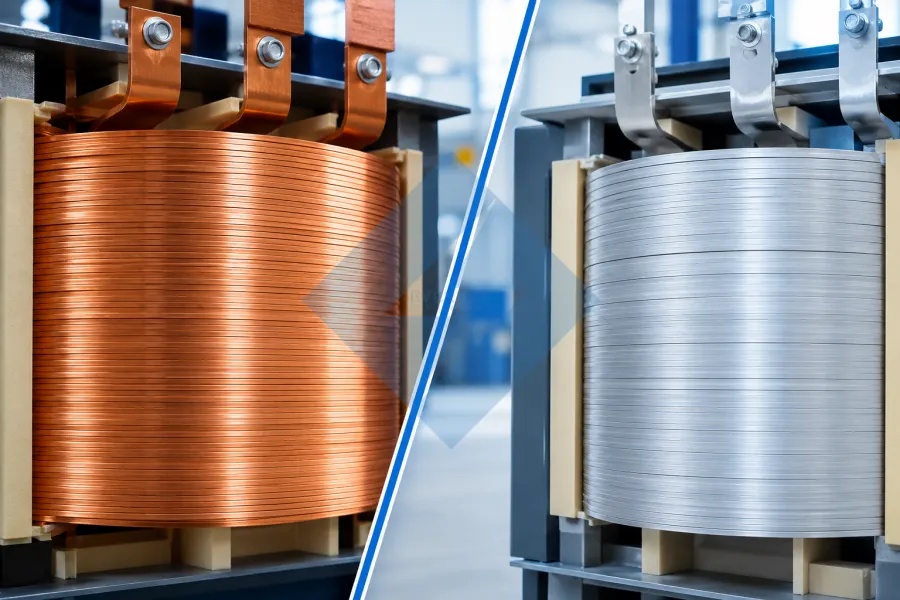
购买时 变压器, one important decision is choosing between copper and aluminum windings. Both materials are widely used in 配电变压器, 干式变压器, and oil-immersed power transformers. However, they differ in electrical conductivity, weight, material cost, and design requirements.
So, which is better: a copper winding transformer or an aluminum winding transformer?
The answer depends on the project’s budget, efficiency requirements, installation conditions, and operating environment. This guide compares both options to help buyers make an informed decision.
1. Copper vs Aluminum Transformer Windings: Key Differences
Copper and aluminum are both suitable electrical conductor materials for transformer windings when properly designed and manufactured.
The main difference is their electrical and physical properties.
| COMPARISON | COPPER WINDING | ALUMINUM WINDING |
|---|---|---|
| Electrical conductivity | 更高 | 较低 |
| Conductor cross-sectional area | Smaller | 更大 |
| 重量 | Heavier | Lighter |
| Raw material cost | 一般來說較高 | 通常較低 |
| Winding design | 更紧凑 | Requires more space |
| Thermal performance | High thermal conductivity | Lower thermal conductivity |
| 应用 | Industrial and high-performance projects | Distribution and cost-sensitive projects |
Copper has approximately 58 MS/m electrical conductivity, while aluminum has approximately 35 MS/m. Therefore, aluminum conductors generally require a larger cross-sectional area to achieve comparable electrical resistance.
However, the final transformer performance depends on the complete electromagnetic and thermal design, not simply the winding material.
2. Copper vs Aluminum Transformer Cost
Cost is one of the main reasons buyers compare these two winding materials.
Copper is generally more expensive than aluminum per kilogram. Since transformer windings require significant amounts of conductive material, copper winding transformers typically have a higher initial manufacturing cost.
Aluminum winding transformers can offer a more economical alternative, particularly for standard distribution applications and projects with strict budget requirements.
However, buyers should not compare material prices alone.
The total transformer cost also depends on:
Transformer rated capacity and voltage levels
Core material and magnetic flux density
Winding configuration and conductor dimensions
Insulation system and cooling method
Design requirements and efficiency targets
Manufacturing processes and quality standards
For large-capacity transformers, the difference in material cost can become significant.
Practical advice: When requesting quotations, ask manufacturers to provide both copper and aluminum winding options where technically feasible. This makes it easier to compare initial investment and overall project costs.
3. Transformer Efficiency and Electrical Losses
Does a copper winding transformer always have higher efficiency than an aluminum winding transformer?
未必。.
Copper has higher electrical conductivity, which can help reduce winding resistance and load losses when comparing conductors of similar dimensions.
However, transformer manufacturers can compensate for aluminum’s lower conductivity by increasing conductor cross-sectional area and optimizing the winding design.
Transformer losses mainly include:
No-load losses: Primarily caused by the transformer core and present whenever the transformer is energized.
Load losses: Mainly caused by winding resistance and other load-dependent effects, including stray losses.
The actual efficiency depends on core design, winding resistance, operating temperature, rated load, and other design factors.
For buyers, the most reliable approach is to compare guaranteed no-load losses, load losses, and efficiency data rather than assuming that copper always provides better overall performance.
Read More:How to Buy Transformers Faster for AI Data Centers: A Practical Procurement Guide
4. Service Life and Maintenance Considerations
Both copper and aluminum winding transformers can provide a long service life when properly designed, manufactured, installed, and maintained.
The lifespan of a transformer is influenced by several factors:
Operating temperature and thermal aging
Insulation quality
Load profile and overload conditions
Moisture and environmental conditions
Cooling system performance
Manufacturing and maintenance quality
Copper has excellent mechanical strength and conductivity. Aluminum is lighter and can also provide reliable performance when appropriate conductor sizing, winding support, and connection techniques are used.
Special attention should be paid to electrical connections in aluminum winding transformers. Aluminum forms an oxide layer on its surface, so suitable connection methods and materials are essential to maintain reliable electrical contact.
Therefore, winding material alone does not determine transformer service life. Overall design and manufacturing quality are equally important.
5. Which Is Better for Different Applications?
The best winding material depends on the application.
Copper winding transformers are often preferred for:
Industrial facilities with demanding operating requirements
Projects with limited installation space
Applications requiring compact winding designs
Projects where specific electrical or mechanical performance requirements justify the additional cost
Aluminum winding transformers are often suitable for:
General power distribution networks
Commercial buildings and infrastructure
Cost-sensitive industrial projects
Applications where lower equipment weight is beneficial
Neither material is universally better. The appropriate choice should be based on technical specifications, performance requirements, and total project economics.
6. What Should Buyers Consider Before Choosing?
Before selecting a copper or aluminum winding transformer, buyers should confirm the following information with the manufacturer:
Rated capacity (kVA or MVA).
Primary and secondary voltage.
Frequency (50 Hz or 60 Hz).
Required efficiency and guaranteed losses.
Permitted temperature rise.
Cooling method, such as ONAN or AN.
Installation environment and ambient temperature.
Applicable standards, such as IEC 60076.
Transformer dimensions and installation limitations.
Initial purchase price and expected operating costs.
It is also important to request technical datasheets and test reports to verify that the proposed transformer meets the project’s requirements.
7. Copper and Aluminum Winding Transformers from EverNew
EverNew Transformer is a China-based power transformer manufacturer and supplier, providing transformer solutions for industrial, utility, renewable energy, and infrastructure projects.
Our product range covers 6–500 kV power transformer applications, with different designs and configurations according to customer requirements.
Depending on the transformer type and technical specifications, copper and aluminum winding options can be considered.
Whether you need a distribution transformer, dry-type transformer, oil-immersed transformer, or a customized power transformer, our team can evaluate your project requirements and recommend a suitable design.
聯絡 EverNew Transformer with your required capacity, voltage ratio, frequency, and winding material preference to receive a technical proposal and quotation.
常見問題
1. Is a copper winding transformer better than an aluminum winding transformer?
Copper offers higher electrical conductivity and allows more compact conductor dimensions. However, aluminum can also deliver reliable transformer performance when properly designed. The better option depends on project requirements and budget.
2. Are aluminum winding transformers less efficient?
Not necessarily. Aluminum has lower electrical conductivity, but manufacturers can compensate with larger conductor cross-sections and optimized designs. Compare guaranteed transformer losses to evaluate efficiency.
3. Why are copper winding transformers more expensive?
Copper generally costs more per kilogram than aluminum. Its higher material cost can increase the overall manufacturing price of a transformer.
4. Do copper and aluminum transformers have the same service life?
Both can provide long service lives when properly designed and maintained. Insulation quality, operating temperature, loading conditions, and manufacturing quality are important factors.
5. Can I request the same transformer design with copper or aluminum windings?
In many cases, manufacturers can offer both options. However, conductor dimensions, winding arrangements, and thermal design may need to be adjusted to meet the same electrical and performance requirements.
6. Which winding material should I choose for an industrial transformer?
The decision should consider load characteristics, efficiency requirements, installation space, environmental conditions, and total ownership cost. Consult the manufacturer before finalizing the specification.
结论
Copper and aluminum are both established materials for transformer windings. Copper offers higher conductivity and more compact designs, while aluminum can reduce initial material costs and equipment weight.
For transformer buyers, the right decision is not simply about choosing the more expensive material. It is about selecting a properly engineered transformer that meets electrical performance requirements and provides reliable operation throughout its service life.
Contact EverNew Transformer to discuss your project and compare suitable copper and aluminum winding solutions.
