
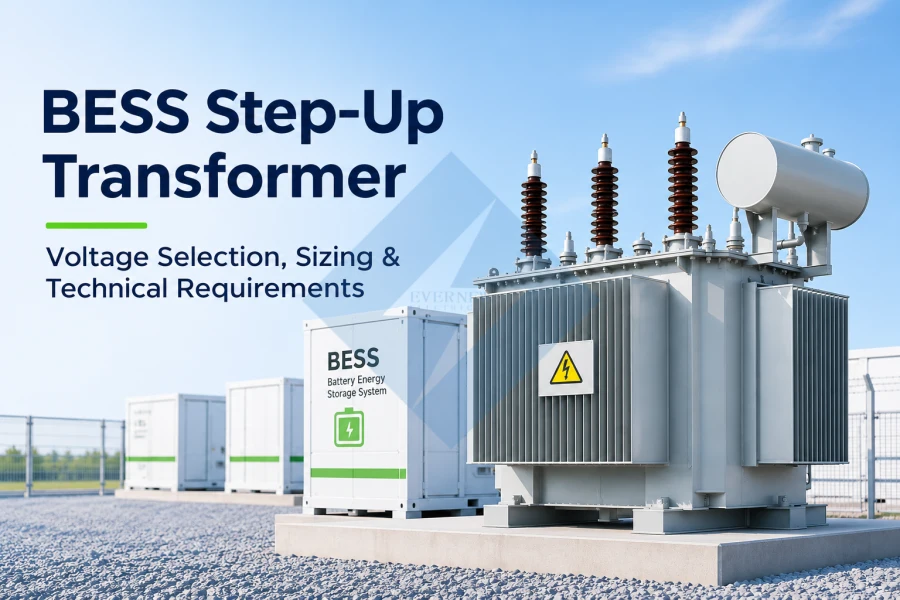
A BESS step-up transformer connects a battery energy storage system (BESS) to a medium-voltage electrical network by converting the low-voltage AC output of a power conversion system (PCS) to the required grid voltage.
Common project configurations include 690 V/11 kV, 690 V/33 kV, and 800 V/34.5 kV, depending on the PCS design and grid connection requirements.
Selecting the correct transformer requires more than matching voltage and power ratings. Engineers must also consider bidirectional power flow, reactive power, harmonics, cooling, impedance, operating cycles, and applicable standards.
This guide explains how to select and specify a BESS transformer for utility-scale and commercial energy storage projects.
1. How Does a BESS Step-Up Transformer Work?
A battery energy storage system typically consists of battery racks, battery management systems (BMS), power conversion systems (PCS), transformers, and grid connection equipment.
The basic electrical arrangement is:
Battery System (DC) → PCS (AC) → Step-Up Transformer → Medium-Voltage Grid
During discharge, the PCS converts DC electricity from the batteries into AC power. The transformer increases the AC voltage to the level required by the collection network or grid connection.
During charging, power flows in the opposite direction. The transformer operates as a step-down transformer, supplying the PCS from the grid.
Therefore, a BESS transformer must be designed for bidirectional power flow and the electrical characteristics of the connected PCS.
2. BESS Transformer Voltage Selection
Transformer voltage selection depends primarily on the PCS AC output voltage and the project’s medium-voltage collection system.
Zu den gängigen Konfigurationen gehören:
| PCS-SIDE VOLTAGE | GRID-SIDE VOLTAGE | TYPICAL APPLICATION |
|---|---|---|
| 690 V | 11 kV | Industrial and smaller BESS projects |
| 690 V | 33 kV | Utility-scale battery storage |
| 800 V | 33 kV | Medium-voltage BESS collection systems |
| 800 V | 34,5 kV | North American project configurations |
| 1500 V AC | 33 kV | Projects using compatible higher-voltage PCS equipment |
These are illustrative configurations, not universal design standards. The PCS output voltage must be confirmed from its technical datasheet.
For example, a BESS project with a 690 V PCS and a 33 kV collection network may require a 690 V/33 kV step-up transformer.
However, the final voltage ratio, tapping range, vector group, and grounding arrangement must be coordinated with the PCS manufacturer and electrical system design.
3. How to Size a BESS Step-Up Transformer
Transformer sizing should be based on the maximum required apparent power, rather than battery energy capacity alone.
Battery capacity is measured in MWh, while transformer capacity is rated in kVA or MVA.
Bei einem Dreiphasensystem:
S (MVA) = P (MW) / Power Factor
Wo:
S = apparent power
P = active power
Power Factor = operating power factor
Example: 2.5 MW / 5 MWh BESS
Consider a battery storage project with:
| PARAMETER | VALUE |
|---|---|
| PCS Active Power | 2.5 MW |
| Battery Energy Capacity | 5 MWh |
| PCS AC Voltage | 690 V |
| Grid Voltage | 33 kV |
| Operating Power Factor | 0.95 |
| Frequenz | 50 Hz |
Assuming the PCS must deliver 2.5 MW while operating at a power factor of 0.95:
S = 2.5 / 0.95 = 2.63 MVA
A 3150 kVA transformer may be considered as an initial candidate.
However, the final transformer rating must account for the PCS apparent-power capability, reactive power requirements, harmonic losses, temperature rise, auxiliary loads, overload duty, and site conditions.
The 5 MWh battery capacity determines stored energy and operating duration; it does not directly determine the transformer kVA rating.
Wichtig: A fixed 10% or 20% sizing margin should not replace project-specific electrical and thermal calculations.
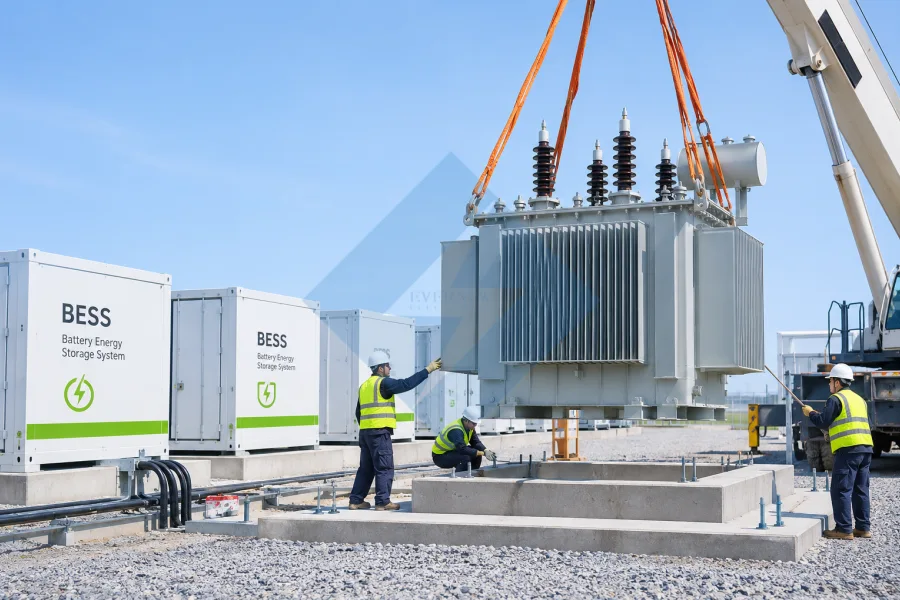
4. Key Technical Requirements for BESS Transformers
4.1 Bidirectional Operation
BESS transformers operate during both battery charging and discharging.
The design should accommodate the specified operating current, voltage conditions, and duty cycle in both directions.
4.2 Harmonic Performance
PCS equipment uses power electronic switching, which can introduce harmonic currents and voltages.
Harmonics may increase transformer losses and heating.
The transformer manufacturer should review the PCS harmonic spectrum, switching-related requirements, and applicable system studies before confirming the design.
A K-factor rating should not be assumed to be mandatory for every BESS transformer.
4.3 Transformer Impedance
Transformer impedance affects fault current, voltage regulation, and coordination with the PCS and protection system.
The required impedance should be established through electrical system studies.
A standard impedance value should not be selected without considering the project requirements.
4.4 Cooling and Temperature Rise
BESS projects may involve frequent charging and discharging cycles.
Common transformer cooling methods include:
ONAN: Oil Natural Air Natural
ONAF: Oil Natural Air Forced
AN: Air Natural
AF: Air Forced
The cooling arrangement must support the specified load profile and environmental conditions.
4.5 Transformer Losses and Efficiency
Transformer losses affect operating costs throughout the project’s service life.
Two important loss components are:
No-load losses: Occur whenever the transformer is energized.
Load losses: Vary with winding current and operating temperature.
For BESS installations that remain energized during standby periods, low no-load losses can be particularly valuable.
5. Oil-Immersed vs. Dry-Type BESS Transformers
Both oil-immersed and Trockentransformatoren can be used in battery storage applications.
| SPEZIAL | OIL-IMMERSED TRANSFORMER | DRY-TYPE TRANSFORMER |
|---|---|---|
| Isolierung | Liquid insulation | Solid insulation and air |
| Kühlung | ONAN / ONAF | AN / AF |
| Einrichtung | Common for outdoor utility projects | Common for indoor or enclosed installations |
| Wartung | Oil-related inspection may be required | No insulating oil maintenance |
| Überlegungen zur Gestaltung | Fluid containment and fire protection | Ventilation and enclosure requirements |
Ölgefüllte Transformatoren are frequently selected for outdoor utility-scale BESS projects.
Dry-type transformers may be appropriate where installation conditions, fire safety requirements, or project preferences favor oil-free equipment.
The final selection should consider technical requirements, lifecycle costs, environmental conditions, and local regulations.
Pad-Mounted Transformers for BESS Applications
Pad-mounted transformers are a popular choice for outdoor battery energy storage systems (BESS), particularly in commercial and utility-scale projects. Their compact, enclosed design allows convenient installation alongside battery storage containers, power conversion systems (PCS), and medium-voltage switchgear.
A BESS pad-mounted transformer steps up the PCS output voltage to the medium-voltage grid level while supporting bidirectional power flow during battery charging and discharging. Common voltage configurations include 690V/11kV, 690V/33kV, and 800V/34.5kV, depending on the project requirements.
Compared with conventional oil-immersed transformers, pad-mounted designs can integrate high-voltage and low-voltage connection compartments, providing a compact solution for outdoor energy storage installations.
Evernew Transformer manufactures customized three-phase Aufbautransformatoren for battery energy storage projects, with project-specific power ratings, voltage ratios, winding materials, and cooling configurations.
6. BESS Step-Up Transformer Specification Checklist
International EPC contractors and energy storage developers should provide the following information when requesting a transformer quotation.
| TECHNICAL PARAMETER | EXAMPLE / REQUIREMENT |
|---|---|
| Nennkapazität | 3150 kVA |
| PCS-Side Voltage | 690 V |
| Grid-Side Voltage | 33 kV |
| Frequenz | 50 Hz |
| Anzahl der Phasen | Three-Phase |
| Material der Wicklung | Kupfer / Aluminium |
| Methode der Kühlung | ONAN / ONAF |
| Vektor-Gruppe | According to system design |
| Impedanz | According to short-circuit study |
| Harmonic Requirements | PCS harmonic spectrum |
| Operating Duty | Bidirectional charge/discharge |
| Geltende Normen | IEC 60076 / IEEE C57 as applicable |
| Einrichtung | Innen / Außen |
| Zubehör | Temperature monitoring, protection and cable terminations |
Providing the PCS datasheet and single-line diagram helps the transformer manufacturer evaluate the project more accurately.
7. Frequently Asked Questions
What size transformer is required for a 2.5 MW BESS?
At 2.5 MW and 0.95 power factor, the calculated apparent power is approximately 2.63 MVA. A 3150 kVA transformer may be considered, subject to confirmation of the PCS rating, operating conditions, harmonics, and thermal requirements.
Can a BESS step-up transformer operate in both directions?
Yes. A transformer can transfer power in either direction. For BESS applications, its design and associated equipment must accommodate the specified charging and discharging conditions.
What voltage is commonly used for BESS transformers?
Common PCS-side voltages include 690 V and 800 V, while medium-voltage collection systems may operate at 11 kV, 33 kV, or 34.5 kV. Actual voltages depend on the PCS and project grid connection.
What standards apply to BESS transformers?
Depending on the project location, transformers may be specified according to the IEC 60076 series, relevant IEEE C57 standards, and applicable local requirements. The exact standards and editions should be confirmed during engineering review.
8. Custom BESS Step-Up Transformers from Evernew Transformer
Evernew Transformer works with Jiangsu Yawei Transformer to support customized power and distribution transformer solutions for renewable energy and battery storage projects.
Available engineering options include oil-immersed and dry-type designs, customized voltage ratios, copper or aluminum windings, and project-specific cooling and accessories.
Our technical team can review transformer requirements based on the PCS specifications, electrical system configuration, applicable standards, and installation conditions.
Request a BESS Transformer Quotation
Planning a battery energy storage project?
Please send us your PCS datasheet, single-line diagram, required transformer capacity, voltage ratio, frequency, harmonic requirements, applicable standards, and project location.
We will review your specifications and coordinate a suitable transformer proposal.
Evernew Transformer – Power Transformer Manufacturing & Export Solutions
